Showing posts with label portrait. Show all posts

Saturday, January 5, 2019

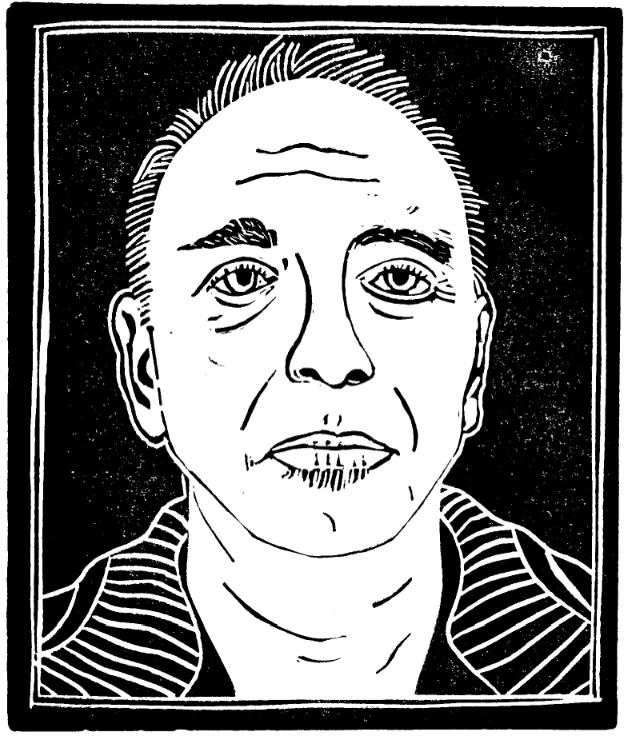
Lou Reed

The first time I heard a Lou Reed song I was 18 years old and floating down the Chattahoochee River in a canoe. A shirtless Georgia teenager stood on the riverbank slapping his paddle at some swimming kids while a boom box blasted "Walk On  the Wild Side." At one point the teen's paddle made contact with a young boy's skull. I heard a loud "thwappp"and the boy fell face first into the water. The teenager laughed maniacally as the boy's friends pulled him to safety.

This is how the music of Lou Reed entered my life. There was something magnetic about the music, the raw and minimal guitar riffs, the shocking lyrics (did he actually say "even when she was giving good head"). Most pop music was safe. Lou Reed was dangerous. The sound had a dark energy, an urgent power with distorted guitars and atonal vocals.

The first Lou Reed album I purchased was Transformer (1972). From the moment he sang the words "Vicious, you hit me with a flower" I realized there was something deeper going on, ironic storytelling in a way I'd never heard. On "Perfect Day" Reed sings, "You made me forget myself, I thought I was someone else, someone good." The line perfectly encapsulated my teenage angst, my self-doubt and dim hopes for future redemption. Reed goes on to repeat the frightening refrain, "you're going to reap just what you sow." The words penetrated my soul like a warning, a call to pay attention to my own words and deeds.

When I discovered the Velvet Underground, I was spellbound. The music was real and edgy as if made in someone's garage. The guitars were droning and slightly out of tune, the drums scratchy and dirty. This was my first experience of lo-fi music and Reed was my first rock star crush.

He was a prototypical rock and roll bad boy. He abused drugs and alcohol, trashed hotel rooms, cursed reporters and engaged in bar brawls. But Reed was different. Where most rockers had affairs with supermodels, Reed opted for trysts with transvestites. While typical pop stars sang about how much they missed old girlfriends, Reed sang about bondage and sadomasochism ("Venus In Furs").

Google the words "Lou Reed was an asshole" and you'll find dozens of incidents describing his brutal, selfish, misanthropic behavior. There was the time he slapped David Bowie after Bowie suggested Reed cut back on his drug and alcohol use. Or the time he called Bob Dylan a "pretentious kike." (Reed himself was Jewish.) His Velvet Underground band mate John Cale called Reed "a twisted scary monster." Paul Morrissey, manager of the Velvets said Reed was possibly "the worst person who ever lived."

Friends and admirers grew familiar with Reed's moody tantrums and profanity-laced assaults. At the Manhattan clothing store RRL a sales clerk told Reed he was a big fan. Reed responded, "I don't know what the fuck you're talking about. Fuck off." Howard Sounes, author of Notes From the Velvet Underground: The Life of Lou Reed writes that Reed "was constantly at war with family, friends, lovers, band members, managers and record companies." Reed even described himself as a "fucking, faggot junkie."

This begs the question does it matter? As a person, Reed was clearly complicated. As an artist, Reed inarguably shaped the musical landscape. Without him there would be no punk rock. (Sid Vicious took his name from the Reed song "Vicious.") There would also be no grunge or shoe gazer scenes. Brian Eno claimed, "everyone who bought the first Velvet Underground album started a band." Reed's songs directly informed the musical style of Joy Division, Jesus & Mary Chain, Galaxie 500, Dream Syndicate, Luna, Spacemen 3, the Dandy Warhols, the Feelies and the Pixies.

Reed was an avant-garde storyteller who wrote about misfits and lost souls. His song subjects were junkies and drug dealers, transsexuals and schizophrenics. He chronicled trips to the bad part of town to buy heroin. In the brilliant but dark album Berlin, he told the story of Jim and Caroline, a troubled couple whose relationship crumbles as they fall into drug use, prostitution, domestic violence and suicide. This is the heady stuff of literature, not the trivial fare typically found in rock music.

Reed's heroes were literary figures like Hubert Selby Jr., Jack Kerouac and Allen Ginsberg. During his days as a student at Syracuse University, Reed started a literary journal called The Lonely Woman Review. He wrote short stories and read poems aloud at St. Mark's Church along with the New York writers Patti Smith and Jim Carroll. Reed studied creative writing with the poet Delmore Schwartz whom Reed credited for teaching him to "use the simplest language imaginable" to impart the heaviest impact. (Schwartz was the inspiration for Saul Bellow's novel Humboldt's Gift.) Under Schwartz's tutelage Reed wrote poems that ultimately became the songs "Heroin" and "Sister Ray."

One of Reed's poems was titled "We The People." The words are as fresh today as they were fifty years ago.

We are the people without right. We are the people who have known only lies and desperation. We are the people without a country, a voice or a mirror. We are the crystal gaze returned through the density and immensity of a berserk nation.

One of Reed's favorite books was the 1963 John Rechy novel City of Night. The book was a landmark of queer literature chronicling a gay street hustler's travels through America. Reed channeled this energy into his own songs about street life such as "Waiting For the Man."

Reed yearned to write the great American novel and put it to music. In a 1991 interview with author Neil Gaiman, Reed explained how he used prose technique in songwriting. "There are certain kinds of songs you write that are just fun songs, the lyric can't survive without the music. But for most of what I do, the idea behind it was to try and bring a novelist's eye to it, to try and have that lyric there so somebody who enjoys being engaged on that level can have that and have the rock n' roll too."

Reed grew up in a middle-class Jewish family in Brooklyn. When he was nine, the family moved to Long Island. His mother had been a teenage beauty queen while his father abandoned dreams of becoming an author to become a tax accountant. At a young age, Reed experienced social anxiety, panic attacks and depression. He spoke of being beat up routinely after school. He escaped into music, mimicking the guitar sounds he heard on the radio.

During high school he formed a doo wop band called The Jades. He also began experimenting with drugs. The band played gigs in shopping malls and dingy bars. His parents were overprotective and fought often with Reed. In one instance an inebriated Reed crashed the family car into a toll booth on the parkway.

Reed waited tables at a local gay bar and began having sexual encounters with men. He tried heroin for the first time and contracted hepatitis. He attended New York University but during his freshman year he had a mental breakdown. His parents drove to the city and brought their son back home. They sought professional help. Psychologists suggested Reed might have schizophrenia. He was briefly admitted to a psychiatric institution where he confessed to homosexual urges. Doctors recommended electroshock therapy. His parents consented and Reed endured more than two-dozen ECT sessions. The treatments wreaked havoc on his short-term memory. Reed never forgave his father, something he wrote about in the 1974 song "Kill Your Sons."

Reed recovered and enrolled at Syracuse University. After college, he moved to New York City and befriended the Welsh musician John Cale. The two became roommates in a lower east side apartment and busked the Harlem street corners, Reed on guitar, Cale on viola. They formed a band initially called the Warlocks then the Falling Spikes. They settled on the name the Velvet Underground (taken from a book about a 1960's secret sex subculture).

In 1965 they met Andy Warhol while playing a gig at the Cafe Bizarre in Greenwich Village. Warhol became the band's producer and the Velvets recorded four studio albums. The albums sold poorly but the work is among the most innovative music of the period. Reed grew frustrated as his peers Bob Dylan and Leonard Cohen skyrocketed to fame. Reed fired Cale, Warhol and the singer Nico and the band disintegrated. Reed had another breakdown and moved back into his parents' home. He took a job at his father's tax firm as a typist for $40 a week. In 1971, he signed a contract with RCA to be a solo artist. His career was back on track.

For Reed, the 70's was a decade of substance abuse and excess. He told a friend he "was going to take meth every day for the rest of his life." He binged on scotch and according to his first wife Bettye Kronstad he became a "violent drunk." During a 1975 tour through Italy he pulled a knife on his violin player and told Italian reporters he came to Rome to have sex with the Pope.  His reputation for misbehavior grew as he hung out with drag queens and became romantically involved with a transgender woman named Rachel.

It wasn't until the late 90's that Reed finally seemed to find a semblance of happiness. He took up meditation and practiced tai chi several hours a day. After two failed marriages he began dating the musician and performance artist Laurie Anderson. The two made several recordings together and were married in 2008.

Reed's years of hard drinking and drug use led to hepatitis and liver disease. He developed liver cancer and underwent a liver transplant in May 2013. After the surgery he posted on his website of feeling "bigger and stronger than ever." He died of liver disease in October 2013. He was 71 years old.

Laurie Anderson wrote that Reed "was a prince and a fighter" and that his last days were peaceful. She did her best to debunk Reed's dark reputation saying, "I never saw the blackness." After his passing, the rock community paid tribute. Bono said, "Every song we've ever written was a rip-off of a Lou Reed song." David Bowie said, "He was a master." Cale wrote, "I've lost my schoolyard buddy." Reed's last tweet posted hours before his death read simply: "The Door." (7" x 9," black ink print)

Monday, January 2, 2017

El Presidente

Looking back, there was a clear sign that Trump might actually win. On Election Day, an angry horde of bees circled our polling place, dive-bombing voters as they neared the front of the line. In the hour I waited to vote, two people were stung. Both were Clinton supporters.

In the months since the election, I'm slowly adjusting to life in Trump Bizarro World. Trump perceives Sean Hannity as Walter Cronkite, Vladimir Putin as Winston Churchill and The New York Times as "fake news." In my own circle of family and friends, Trump's hammer blows have wreaked havoc. My dental hygienist, a woman from Iran, cancelled a trip to visit her dying father in Teheran for fear she may not be let back into the States. My mom's caregiver, a lovely lady from Belize, is terrified she'll never see her family again. My wife and I wonder if we're on the verge of losing our health insurance (we're grateful for Obamacare) and my aging father is afraid Medicare and Medicaid are about to unravel.

I understand I live in a Los Angeles bubble and my views are out of touch with most of the country. What's troubling is how many friends and family are coming out as Trump supporters. It's as if I'm suddenly in a scene from Invasion of the Body Snatchers where alien walk-ins have possessed those around me and no one is who they seem.

My grandfather always advised me to see the world from someone else's shoes. In this spirit, I've opted to leave the shores of the familiar and take a journey to Trumpland. The voyage might be terrifying and I may lose my mind. But as a member of the losing team I've deigned to extend an olive branch and ask the Trump supporters in my life to explain their views.

First on the list is my favorite cousin Dave. We meet at a Coffee Bean & Tea Leaf in Pacific Palisades. Dave's a real-estate investor with properties all over town. He owns a beautiful home overlooking the Pacific Ocean and has two lovely daughters and an amazing wife. In the eight years under Obama, Dave did incredibly well financially, but he's happy to see Obama go. When I ask him why, his answer is simple. Israel.

"Obama was an enemy to Israel. He opposed new settlements and refused to veto the UN resolution against Israel. He went out of his way to insult Netanyahu and made a stupid deal with Iran, Israel's greatest enemy. Trump supports Israel and understands that a two-state solution is impossible. He realizes Israel is our only true ally in the Middle East. He knows you can't negotiate with terrorists and you have to rule with strength."

I ask Dave why half the Israeli population supports a two-state solution if it's impossible. "Because they're stupid and weak. Too many Jews are self-hating. We live in an anti-Semitic world and if you don't see this you're blind. Only the strong survive and Trump is strong." I ask Dave his opinion about Trump's advisor Steve Bannon, a supposed anti-Semite. "Bannon doesn't hate Jews. He hates Muslims. Don't let the liberal media brainwash you."

Next on my list is Andrew, a basketball buddy who works as an Emergency Medical Technician. Andrew has saved more lives than all my friends combined.  He's a strapping man from Ohio with a good sense of humor and a deep baritone voice. When I ask why he supports Trump, he morphs into Archie Bunker. "Gangs. I'm tired of seeing the Mexicans and the blacks kill each other. In the 14 years I've driven an ambulance in Los Angeles, I've seen almost a thousand gunshot victims. You know how many were white? Less than 10. I'm sick of it. Black Lives Matters is a terrorist organization but Obama made them acceptable. Now we have monsters hunting cops and illegals living off welfare. We need tight borders. We need to keep out the illegals and put the gang members in jail. Trump's the only guy who has the balls to make this happen."

I ask Andrew to expound on "the Wall" and who will pay for it. "Who cares? Once we keep out the Mexicans we won't have to support them anymore. We can take that money and use it on border security. It might be a wall, it might be a fence…you should listen to what Trump means, not what he says."

I parted ways with Andrew and met Lynn, an accountant from Orange County. Lynn's a devout Christian in her 60s who works for a software company. We met at a record company in the early 2000s. Despite our differing backgrounds, we became friends. Lynn's support for Trump is based on his stance toward abortion. "I've always been pro-life. For the first time I see a chance to overturn Roe vs. Wade. Trump is a wild card and I don't like his attitude toward women. But Hillary was pro-abortion. There's no way I could have voted for her. That's why I voted for Trump. It's the only way I could live with myself."

Next is Jeremy, an artist I met at a local coffee house. Jeremy creates wall-sized assemblage paintings incorporating items found in junkyards. Given his aesthetic leanings, I assumed he was liberal. Then I visited his studio and saw a painting featuring an image of Obama with horns. I asked him to explain the imagery. "The devil is the father of all lies. He's clever, handsome and charming. His smile melts our hearts and we let our guard down, unaware of his guile. This is how the false prophet gains control of the world. And this is how Obama allowed his minions into America. Trump sees what's happening. He calls a spade a spade. We need someone rough and tumble to save us from the last eight years. Trump is our only hope."

I parted from Jeremy feeling rattled. The final person on the list was Adam, a motion picture camera operator. We met while working on a film in the 90's. In the subsequent years, Adam worked his way to major Hollywood movies. He bought a house, got married and had kids. All was rosy until the digital revolution hit the film industry. Then his career slowed and good jobs became hard to find.

"Obama seems like a good guy. But he hasn't been a leader for everyone. I think in his heart he cares more about minority issues than the everyday struggles of white people. It's not his fault. It's his background. He was a community organizer and spent most of his time with poor blacks. They need help, I understand. But so do we. In the eight years Obama was in office, I've struggled. I used to work six films a year. Now I'm lucky to get one. It's time for a change. Trump might be crazy but the world is crazy, right? Maybe crazy is what we need."

Adam was reasonable in his support of Trump though his conclusions were correlational instead of causal. I understood his sentiments and why he wanted a new direction for the county. He has nothing to lose. Or so he thinks.

As I returned from Trumpland, I reflected on the journey. What did I learn? One, I'm a self-hating Jew. Two, I should "listen to what Trump means, not what he says." Three, Obama might be the anti-Christ. All the Trump supporters in my life were white, over the age of 50 and homeowners. More importantly, everyone seemed normal (except for Jeremy) and were just trying to do their best for their family and themselves. Trump might erect a wall but it's important I don't do the same. (6" x 8", black ink print)

Thursday, October 6, 2016

The Spiritual Teacher

"Right now, right here, you are free."  With these seven words George Falcon began each session.  The topic was always the same.  Who are we?  How do we live a spiritual life and what does this mean? Though he was unknown to the masses, George touched thousands of people and influenced multitudes of lives. He was a mentor, a teacher, a spiritual guide, a man of peace.  To know George was to know God exists.

I'd heard about George for years.  He was married to my best friend Lee's sister Belinda. Lee and I would have deep discussions about life and he would always say, "you have to meet George. He's amazing."

I met George at a Christmas dinner with Lee's family in 1986.  He sat at the end of the table with his aging parents.  He was professorial in appearance, with a thick beard and olive skin that belied his Latino heritage.  He wore a blue Adidas tracksuit (his standard uniform) and he was quick to smile and laugh.  Dinner conversation was lively and entertaining, but George was largely quiet.  When the conversation shifted to spirituality, I expected him to say something.  Instead he was content to listen in silence tending to his parents' needs.  When dessert was served, he took his plate of pie and ice cream and wandered to the living room to watch the Bulls play the Knicks.

George loved basketball.  This was how we first bonded.  We talked for hours about the Lakers and their chance at another championship.  He spoke about Magic Johnson and Michael Jordan and how they both hated losing more than they loved winning.  This prompted the first question I ever asked George.  "Are you saying hate is more powerful than love?"

He answered something to the effect of "love is a higher frequency emotion but sometimes we act more urgently to avoid the pain associated with hate." These spiritual/basketball talks were my first George lessons.  He loved to tell the story about Scottie Pippen and Karl Malone in the 1987 NBA Finals.  Game 1 was on a Sunday and with nine seconds left, Malone (nicknamed "The Mailman") had two free throws to give Utah the win.  Pippen stepped in front of Malone and said, "the Mailman doesn't deliver on Sundays."  Malone missed the shots and the Chicago Bulls won the game.  George used the story to emphasize the power of the "low self" over the body.  Pippen's statement was a subliminal suggestion planted in Malone's subconscious.  Malone could have countered the suggestion with his own statement such as "cancel cancel" as if to say 'I'm consciously canceling the words spoken to me.'  Instead, Malone took the bait and his body betrayed him.

It's been said when a student is ready a teacher will appear.  George was this teacher and I was a grateful and spellbound student.  I attended my first formal "George talk" in the late 80's.  We met at George and Belinda's Studio City home, about twenty of us seated on couch pillows around the living room. George began with a meditation, leading us through a series of breathing exercises to quiet the mind.  After fifteen minutes, George began the talk.

He spoke about consciousness and how the early Egyptians divided the mind into the low-self, middle-self and high-self.  The low-self corresponded to our subconscious, where the mind generates feelings, pictures and memories. George called the low-self "Annabelle," inspired by his small dog who was always yapping for attention.  This is how the low-self works.  While we attempt to quiet our mind we're distracted by noise such as hunger pangs or unpleasant feelings and memories.  Our job is to train our low-self to be aware of the distractions but not let them control our actions, like George ignored Annabelle's barking.

The middle-self is our conscious mind or intellect, where words, ideas and reasoning prevail.  George called the middle-self "Virgil," a nod to Dante's guide through hell in Dante's Inferno.  (In the story, Virgil lived a virtuous life on earth but was trapped in limbo unable to access heaven…an apt metaphor for our middle-self.)  The middle-self, our rational mind, can speak of concepts such as heaven and nirvana, but is unable to grok these experiences.  As George often said, "Virgil can lead you to the doorway, but he can't take you through."

The low-self and middle-self work together to create our identity, our ego, "the self." The low-self generates an emotion and the middle-self comes up with a story to explain the emotion.  The story is a "lie," but we believe it.  Over time, we become hypnotized by our individual stories.  We believe we are selves, separate from others and the world at large.  This leads to the major struggle of humanity, loneliness and a feeling of disconnection (from others and God).

The high-self is where we begin to recognize we are not that which we call "the self."  This is where we find freedom, where we touch love and peace.  The high-self is where we glimpse our true essence, where silence allows us to hear the "still small voice" inside.  George called the high-self "Beatrice," a tribute to Beatrice Portinari, the woman who inspired Dante's Divine Comedy.

George acknowledged the world can appear difficult, rife with pain and violence.  But he reminded us "reality is illusory."  Our world view is informed by the consciousness we resonate with.  The best way to change your reality is to shift your consciousness.  The intellect (middle-self) wants to remain in charge but our job is to be still, to observe our thoughts and feelings and return to our breath through meditation.  We are magnetic beings attracting a reality that matches our beliefs.  If we resonate with harmony, our life becomes more harmonious.  If we focus on discord, our life becomes more chaotic.

The George talks were high-minded and fascinating, but initially they had little impact on my life.  It wasn't until I experienced a personal crisis that I began to view the teachings differently.  I was 28.  I was living in San Francisco and my life was a mess.  My relationship was crumbling, my finances were dismal, my creative life was stunted and I felt like I was having an emotional breakdown.  I called George and asked if we could meet in Los Angeles.  He agreed and I drove to LA the next day.

I met George at a cafe in Larchmont Village.  He listened patiently as I explained how my life was falling apart.  After a few minutes he asked, "If your life was a basketball game what would you do right now?"  I thought for a moment.  "I'd call timeout."  "Good," he said.  "And what would you do during the timeout?"  "Rest for a moment and change my strategy." "Good," he said.  "Maybe you need to rest and design new plays."  "I can't rest, George.  I'm broke.  If I sit back and do nothing how am I going to pay my bills."  "I didn't say do nothing.  I said rest."  I was confused.  "How do you rest while you're active?"  George smiled.  "Now you're asking a good question."

George discussed how meditation allows you to take a break from the usurping energy of negative thoughts and feelings.  He said an hour of meditation equates to six hours of deep sleep.  He added that all emotions have a rhythmic counterpart in breathing--anger corresponds to one breathing modality, depression another.  By learning to consciously control my breathing rate I could begin to assert control over my low-self which at that point was controlling me.

George's words had extra weight given his own recent history.  In 1990, George was diagnosed with colon and liver cancer.  Lee and I visited him at the hospital the night before his surgery.  We expected to find a somber hospital room filled with anxiety and fear.  Instead, George gave an inspired talk to family and a few close friends.  He was smiling and energetic, no sign of worry.  The subject was "freedom" and how to proceed when your external reality does not match the perfection within.  I was stunned at how a man on the verge of life-threatening surgery was able to exhibit such equanimity.

The day after surgery, George was walking the hospital hallways.  He was released two days later.  Doctors estimated a six-month healing period but George was confident he'd need half that time.  He woke at 4:00 am each day, immersing himself in deep meditation while seated in his favorite leather chair. He ate judiciously, mainly fruit, broth and water.  Belinda acted as gatekeeper, keeping visitors away so George had time to heal.  I visited him a month after his surgery. He was quiet and reserved, his face thin and ashen.  He had a distant look, as if lost in thought.  Years later he explained he was focused on the inner healing tones above his eardrums, a meditation technique he would soon teach his students.

Two months after surgery, George was giving talks again.  He looked fit and healthy, back to his pre-surgery weight and jovial as ever.  Rather than curtailing his schedule, he dove into his teachings with a vengeance.  He gave talks at galleries, restaurants, yoga studios, production offices and private homes.  He resumed seeing private clients, working 12-14 hour days.  On any given day he drove as far south as San Diego and as far north as Santa Barbara.  It's as if he were suddenly conscious of his limited time on earth and wanted to make sure not a second was wasted.

In 1991, I moved back to Los Angeles.  I began seeing George twice weekly for private sessions.  He asked me about the tattered journal I carried with me. I told him this was where I recorded my daily thoughts and feelings.  "So that's your low-self and middle-self manual," he said.  I never viewed it that way but he was right.  "It's time to begin a high-self manual," George said. He gave me an assignment.  Purchase a new journal and fill two pages a day with a single statement written over and over.  The statement: "I am the Temple of the Living God."

I hesitated.  I knew George was Christian.  Having grown up in a Jewish household with Orthodox grandparents, I was worried I was entering dangerous ground.  I voiced my concerns.  "George, I'm Jewish.  I don't want you to try to make me a Christian.  I'm not comfortable with that and to be honest, the thought scares me." George smiled.  "Have I mentioned anything about Christianity?" "No," I said. "Have I mentioned Christ?"  "No."  "Have I mentioned religion?"  "No." "We spoke about designing new plays.  That's all we're doing right now."

I began journaling immediately.  At first it was awkward.  I felt like Bart Simpson trapped in a Catholic school principal's office.  After a few days, the words became a mantra.  I spoke them aloud as I transcribed page after page with the sentence "I am the Temple of the Living God."  The writing was soothing and questions entered my mind.  Does "the Temple" refer to my body or my spirit?  Who is the "I" in the statement--my mind, my feelings, my soul?  If I am "a Temple of the Living God," does this mean God is alive inside me?

I noticed small changes in my life.  I became more attentive to cleanliness, shaving and showering each morning instead of waiting until the end of the day.  I ate better, avoiding alcohol and sugar and opting for salads and fresh fruit.  I cut back on my use of profanity (f-bombs were my adverb of choice).  I became more conscious of the movies and books I selected, choosing positive stories instead of dissertations on life's misery.  I started making lists of things to be grateful for, the warmth of a sunny day or the simple miracle of indoor plumbing.

Slowly, imperceptibly, my life improved.  I found a job with a bunch of friends.  I reconnected with Lee.  My aunt gave me a car.  I began dating a beautiful woman from my past.  And I spent more time with George.  Monday mornings became "Breakfast With George" as Lee and I joined him at a Spanish restaurant on 3rd Street.  While George ate his favorite dish chilaquiles he used Lee and I as guinea pigs to practice new spiritual teachings.  He emphasized the need "to take it to the marketplace," using the lessons as a practical means to improve your life.

On one occasion, a couple was having an argument at a nearby table.  The spat devolved into a screaming match.  George said, "This is a great opportunity to practice peace.  What are some things we can do right now to help this couple?"  I said, "We can pray for them." "Good," George said.  "But if you're praying for a desired outcome--their peace--then it's your will doing the praying."  Lee added, "We could ask God to pray for them"  "Better, but again it's you asking God for a specific outcome instead of deferring to God's will."  I said, "We could visualize them in the light."  "Good," George said.  "But there's something you're both missing."  Lee and I were stumped.

George used the occasion to deliver an important spiritual lesson.  Rather than focus on the couple who was having a fight, he directed us to focus on ourselves. He asked us to close our eyes and begin our breathing exercises. He told us to imagine a feather resting on our upper lip.  Our breathing should be calm as to not disturb the feather.  He directed our attention to the center of our foreheads, to our pineal gland, our "third eye."  He said to focus on the peace inherent in our breathing, urging us to watch for a bright white light that would appear in the proximity of our pineal gland.

After several minutes, George asked us to open our eyes.  He asked how we were feeling.  Though neither of us encountered a bright white light, we both felt a sense of profound peace.  "What else," George asked.  We looked around the restaurant. The dining room was quiet and the couple had left. During the meditation, I'd lost focus on the couple.  I was only aware of a feeling of peace.  As I returned to "reality," my outer life resembled my inner tranquility.  I recalled a quote attributed to Martin Luther King, Jr.:  "Be the peace you wish to see in the world."

George gave us a valuable lesson, one he would soon crystalize in his teachings.  "Right now, right here, you are free."  The world outside is connected to the world inside.  ("As below so above.")  When dealing with a perceived problem (illness), our first step is to acknowledge our true essence is free from all lack.  Step two is to recognize the perceived problem as a lie (illness cannot exist in the presence of perfect health).  Next, we are to visualize imagery that reminds us we are part of a divine whole.  This might be a wave in the ocean or the branch of a tree.  We then turn to the breathing exercises.  We focus on our breath, becoming still and quiet, releasing the thoughts and feelings that appear.  The longer we remain in this state, the faster our outer world will resemble our inner one.

George continually reminded us there is "power and wisdom in letting go."  By choosing to release a negative thought or feeling, we are opting for universal consciousness over self consciousness.  He spoke of theosis, a divine union without distinction.  He referenced the Zen Buddhist concept of "not two," falling short of saying we are God but recognizing we are not apart from God. He utilized a myriad of Eastern philosophical texts, urging us to read the Diamond Sutra and the Tao Te Ching.  His favorite quote from the Tao was "the Tao does nothing yet leaves nothing undone."

George often referenced movies in his teachings, particularly ones that featured master-student relationships.  These included The Karate Kid, The Matrix, HoosiersRemo Williams and Star Wars.  He adored the films of Steven Seagal and Chuck Norris and especially loved Bruce Lee's Enter The Dragon.  His favorite tv show of all time was Kung Fu.  He also loved reading.  Two of his favorite books were The Screwtape Letters by C.S. Lewis and The Life and Times of Joseph L. Greenstein written by Kung Fu creator Ed Spielman.

Some of my favorite memories include pick-up basketball games with George and Lee at parks around town.  George was a stellar basketball player in his teens and his love for the sport remained into his 60's.  He was a trash-talker on court, goading players toward their weak spot then blocking the shot with surprisingly quick hands.  Once George tried to steal the ball from an opponent and dislocated his right index finger.  He closed his eyes and bent the finger back into place.  When I asked if he was okay, he replied, "I always suspected that finger had karma."  (Who knew body parts had karma?)

Driving with George provided additional lessons.  He drove like an old lady, observing the speed limit and granting others the right of way.  When someone tailgated or honked at George, he pulled over and let them pass.  Once, George and I left a restaurant in separate cars headed for his home about six miles away.  I drove in my typical frenetic style, constantly changing lanes and passing slower cars.  I made it to his house only thirty seconds faster than him.

My connection with George ran deep.  I encountered him while visiting the Grand Canyon in the 90's.   A few years later my wife and I ran into him while vacationing in Hawaii.  In 2007, my wife and I were honored to have George preside over our wedding.  We participated in a six-week marriage course with George where he reminded us our union was a three-way contract between ourselves and God.  Having George seal our marriage pact made the ritual sacred and profound.

Over time, George focused on the role the body plays in spiritual progression.  Perhaps inspired by his own illness in 1990, he recommended that students observe their own relationship to sugar, wheat, caffeine, alcohol, meat and dairy.  It wasn't unusual to find George in the midst of a juice-only detox or raw-food cleanse.  He offered meditation seminars incorporating water-only regimens emphasizing the need to cleanse the body of toxins.  He gave day-long workshops urging complete silence, focusing only on one's breath and asanas.  His goal was to show us we were not just free from negative thoughts and feelings but from the addictive foods and chemicals that often controlled our lives.

George and I always called each other on our birthdays catching up on the Lakers and their hopes for the coming season.  Though we saw each other less frequently, I applied his lessons every day.  I'd be walking somewhere and I'd recall one of his statements as if he were speaking the words anew.  "God does not give you his life to improve your life.  He gives you his life so you have His life."

As the years progressed, George attracted a new group of students.  He increased his workload, leading more workshops and seeing a wider array of clients.  His teachings became available online attracting new acolytes from around the world. Those close to George urged him to slow down.  But he was dedicated to service and continued a torrid pace into his mid-70's.

For some reason, I forgot to call George on his birthday in April, 2016.  A few months later, I left him a message.  Strangely, he didn't call back.  Early on the morning of July 22nd, Lee called.  He was crying and his words were faint. "Georgie is gone," he said.  "He left us last night."  At the age of 78, George's cancer had returned.  He kept the news to himself, sharing it only with those closest to him.  The illness was fierce and spread quickly.  His body was ravaged and he died in a month's time.

As word spread, a wave of shock spread through the community.  Like most of his his students, I was stunned.  How could George die?  This seemed impossible.  We knew he was mortal, but he seemed beyond death as if he'd mastered life and all it's pitfalls.  Everyone thought the same thing, that George would continue teaching into his 90's like the wise old Yoda we knew him to be.  Now he was gone.

I lived the next few weeks in a fugue state.  At the memorial, George's students expressed a similar sentiment.  People gave heartfelt tributes, sharing how George had rescued them from addiction or saved their marriage or guided them through a life-threatening illness.  We heard anecdotes about George's love of kung fu movies and his penchant for See's chocolates.  We hugged and cried and reminded each other that George's spirit was still intact, he'd merely left his body.  Beneath everything there was a deep sadness.  George had been a father figure. Now, suddenly, we were all on our own. Only one thought gave us peace.  "Right now, right here, George is free."
(5" x 7", black ink print)

To view videos of George Falcon's teachings go to: https://vimeo.com/georgefalconteachings

Sunday, May 22, 2016

The Ventriloquist Dummy

Recently I was teaching a printmaking class at a senior home when I encountered a woman named Phoebe who'd lost her right arm.  We began talking and she shared her story. She'd been a ventriloquist of some renown in the early 70's. She and her puppet Rudy appeared on television programs like Captain Kangaroo and Hobo Kelly.  By 1980 her career slowed and the tv appearances stopped.  Her husband convinced her to give up ventriloquism and she found a job as a secretary.

"I put Rudy in a big wood box and stored him in the back of the closet.  At night I could hear him screaming, 'let me out, let me out.'  After a few weeks Rudy started threatening me, saying things like, 'you'll be sorry,' or 'if you don't let me out, I'm going to hurt you.'  I cried every night.  I told him how sorry I was.  But I never let him out."

In 1981, Phoebe felt pain in her right arm, her puppet arm.  She was diagnosed with advanced bone cancer.  She had emergency surgery and her arm was removed at the shoulder.  Her life was saved, but her performing career effectively ended.  "I killed Rudy," Phoebe said.  "He tried to kill me."

Ventriloquism, the art of throwing one's voice so it appears to emanate from somewhere else, dates back to Classical Greece.  Early ventriloquists were called "engastrimyths" (gaster for stomach, mythos for speech).  Onlookers believed ventriloquists had demons in their stomach belching forth language from the host's mouth.

In the book I Can See Your Lips Moving: The History and Art of Ventriloquism, author Valentine Vox writes that the roots of ventriloquism lay in necromancy. It was believed that ventriloquists channeled the spirit of the dead through holes in their body via nostrils, ears, mouth and anus.  Biblical law specifically forbids necromancy as is written in Deuteronomy: "To seek truth from the dead is abhorred by God" and punishable by death (Leviticus).

Early ventriloquists sought to convince people their practice was religious in nature.  At the Temple of Apollo in Delphi, the Pythia (high priestess) translated the strange utterances from her mouth as if the sounds were prophecies from the gods.  Centuries later, ventriloquists were consulted as a means of speaking with lost love ones.  People paid good money to converse with a recently deceased husband or long dead mother.

In 16th Century France, a nun named Elizabeth Barton uttered worldly predictions via ventriloquism.  She openly stated that King Henry VIII should not marry Anne Boleyn.  She was hanged and the king was married.

In 17th Century Europe, ventriloquism transformed from a medium of divination and prophecy to that of entertainment.  Ventriloquists appeared at traveling fairs and local markets.  In 1753, Englishman Sir John Parnell gained fame as a ventriloquist speaking through his hand.  The first known use of a ventriloquist puppet came in 1757 when Austrian Baron de Mengen incorporated a small doll into his show.

The first ventriloquist in America was James Rannie, a Scotsman who arrived in Boston in 1801.  He performed with a doll named Tommy that resembled a man but was the size of a small child.  Rannie engaged in ventriloquist pranks like the time he asked a female fishmonger about the freshness of her fish. She told him the batch had been caught the previous day.  One of the fish suddenly spoke, "It is false, I am a week older."  The woman was forced to throw away all her catch.

The 19th Century was the golden age of ventriloquism.  Early practitioners imitated animals, birds and the voices of young children.  They became adept at throwing their voices and causing sounds to emanate from men's snuffboxes and women's handbags.  Fred Russell is known as the father of modern ventriloquism.  His puppet "Coster Joe" sat on his lap and engaged him in cheeky dialogue.  He became a vaudeville hit in America and Canada.

By the 1930's, one of the biggest stars on radio was ventriloquist Edgar Bergen with his puppets Charlie McCarthy and Mortimer Snerd.  Bergen popularized the comedic ventriloquist routine with rapid-fire wisecracks and one-liners.  In her autobiography Knock Wood, Bergen's daughter Candice Bergen wrote that she was raised as Charlie McCarthy's kid sister.  She recalled sitting on her father's lap and being urged to talk with her wooden brother who sat across from her.  "For me as a child," Candice Bergen wrote, "Charlie McCarthy had semi-human status.  He wasn't flesh and blood and he wasn't a doll.  He was a sacred calf.  He brought home the bacon."

Ventriloquism has always had an element of creepiness.  The dummy has wild, rabid eyes, arched eyebrows and a crude, hinged mouth that clicks open like a mousetrap.  When draped across a table or chair, away from the performer, the doll's floppy limbs resemble that of a dead body.  But the eyes remain open and the mouth is fixed with a terrifying smile as if the body is a poorly embalmed child corpse.  Adding to the creepiness is the performance itself.  The ventriloquist is often an older man with his hand up the backside of a young puppet boy sitting innocently on the man's lap.  The specter of pedophilia is unavoidable.

Many people are terrified of ventriloquist dummies.  The condition is called automatonophobia.  Hollywood has taken advantage of this fear, making films like Devil Doll (1964) where a possessed dummy possesses his master and Magic (1978) where ventriloquist Anthony Hopkins commits murder under the guidance of his deranged puppet "Fats."

Ventriloquism remains a subversive entertainment medium.  Performers utter their darkest most obscene thoughts and blame it on the puppet.  British ventriloquist Nina Conti says ventriloquism is a "sort of licensed tourettes.  I'm shocked by what the puppet can get away with, things I could never say myself." (6" x 8", black ink print)

Sunday, March 20, 2016

Bowie

As a teenager, I suffered from depression.  I woke most days with a sense of ennui and hopelessness. My dark moods informed the music I listened to and led me to 80's gloom rock like Nick Cave, Bauhaus, The Damned and The Chameleons.  Occasionally I encountered albums so bleak I referred to them as "snuff music." Among these were The Cure's Pornography, Joy Division's Closer and David Bowie's Low.

Low was written and recorded in 1976 during a period when Bowie was attempting to kick cocaine. At the time, his close friend Iggy Pop was in a psychiatric hospital trying to overcome a heroine addiction. Bowie's life was bleak and chaotic and he was obsessed with black magic, the Holy Grail and paranoid delusions.  He moved to Berlin and took an apartment above an auto parts store.  Written with Brian Eno, Low is a musical exploration of anguish and suffering as Bowie struggled to remain sober.  The album became the first of Bowie's "Berlin Trilogy" (along with Heroes and The Lodger).

As my own teenage moods spiraled downwards, Low became an expression of my internal pain.  I identified with Bowie's torment and the music helped me access my own darkness.  I played the album over and over, sinking deeper into the abyss with each listen.  At one point I could no longer handle the distress.  I literally burned the album in a ritual bonfire along with Leonard Cohen's Songs of Love and Hate and Lou Reed's Berlin.

Years went by and I discovered meditation, prayer and therapy.  Slowly, through God's grace and the passage of time, my depression lifted.  My twenties became a decade of growth and self-discovery and my musical choices reflected this shift.  I turned to albums that encouraged healing and a return to life.  At the top of my list were Peter Gabriel's So, Tears for Fears The Hurting and my favorite, David Bowie's Hunky Dory.

Hunky Dory is a poetic and musical celebration of life.  Though written in 1971 before Low, the album celebrates a new outlook for Bowie, one filled with hope, artistic experimentation and the inklings of joy.  Starting with the song "Changes," Bowie reflects on the "changes…I'm going through" in a Buddhist-like fashion.  He sings, "I watch the ripples change their size but never leave the stream of warm impermanence."  He has learned that all things in life are temporary, even suffering.  In the song's chorus, he urges us to "turn and face the strange, turn and face the strain."  This was a perfect accompaniment to the advice my own therapist was giving me: "face your pain, accept it and let it go."

On the song "Quicksand," Bowie acknowledges his unhealthy obsession with the occult, referencing Aleister Crowley and the frightening image of Himmler and the Third Reich.  He sings that "he's torn between the light and dark" and that "he ain't got the power anymore" to avoid "sinking in the quicksand of my thought."

Listening to Bowie's words, I felt as if he were speaking directly to my soul.  At the time I was reading books like The Road Less Traveled and the Tao Te Ching.  Hunky Dory became the soundtrack for my spiritual journey. Everything in life was teaching me that freedom comes with letting go of the ego (death of the Self) and aligning with universal energy.  Buddha spoke about surrendering one's beliefs allowing the mind to move toward release. As Bowie sings on "Quicksand"--"Don't believe in yourself, don't deceive with belief.  Knowledge comes with death's release."

The most joyous and life affirming song on Hunky Dory is "Fill Your Heart." Written by comedian Biff Rose (writer for George Carlin) and Paul Williams (songwriter for Barbra Streisand and Karen Carpenter), "Fill Your Heart" is a paean to peace and comfort.  The song promises that the suffering of life can be overcome through the power of love.  Bowie tells us, "fill your heart with love today, don't play the game of time.  Things that happened in the past only happened in your mind."  When he sings, "Happiness is happening, the dragons have been bled," it's as if Bowie is celebrating the future slaying of his own demons of addiction.  Buddhist energy runs throughout the song culminating in the lyrics, "Fear's just in your head, so forget your head and you'll be free."

"Fill Your Heart" was clearly sentimental and sugary, but it got me every time.  Like Bowie, I'd had enough of pain and misery.  I yearned for joy.  Being new to the happiness game, my initial forays were a bit simple. But they were earnest.  Jesus proclaims in the Gospels, "Unless you turn and become like little children, you will never enter the Kingdom of Heaven."  Bowie helped me become a child again, rediscovering the simple act of smiling. Perhaps this seemed infantile to others. But to me, I was learning to enjoy life.  And for this, I am thankful to Mister Bowie. (5" x 7", black ink print)

Tuesday, October 27, 2015

Twain

Ernest Hemingway wrote, "All modern literature comes from one book by Mark Twain called Huckleberry Finn." Yet less than a year after it was published in 1884, The Adventures of Huckleberry Finn was banned by several American libraries for obscene language and moral degeneracy. In Concord, Massachussetts, the librarian said the book "is not suitable for trash."  Twain responded, "This will sell us sell us another twenty-five thousand copies for sure!"

To many Twain scholars, Huck Finn exposed the hypocrisy of slavery in a democratic republic while humanizing the slave Jim.  Twain's critics claim Huck Finn depicts Jim as a minstrel stereotype prone to superstitious and ignorant beliefs.  In 1957, the NAACP accused Huck Finn of containing "racial slurs" and "belittling racial designations."  In 2009, a Washington state high school teacher called for the removal of Huck Finn from the school's curriculum.

Twain himself was nonplussed by public reception. He said, "I wrote Huck Finn for adults exclusively and it always distressed me when I find that boys and girls have been allowed access to them.  The mind that becomes soiled in youth can never again be washed clean.  I know this by my own experience and to this day I cherish an unappeased bitterness against the unfaithful guardians of my young life who not only permitted but compelled me to read an unexpurgated Bible through before I was 15 years old.  None can do that and ever draw a clean sweet breath again on this side of the grave."

Twain claimed the character Huck was inspired by his childhood friend Tom Blankenship whose father was a drunk and the model for Pap Finn.  But in many ways Huck was inspired by Twain himself.  Like Huck, Twain grew up in the pre-Civil War South.  Twain's home state of Missouri was a slave state and Twain's uncle owned 20 slaves.  In his autobiography, Twain wrote, "I vividly remember seeing a dozen black men and women chained to one another…awaiting shipment to the Southern slave market.  Those were the saddest faces I have ever seen."

As he matured, Twain's attitudes toward slavery evolved.  Twain married into an abolitionist family and his father-in-law, Jervis Langdon, was a conductor on the Underground Railroad who at one point housed Frederick Douglass. Commenting on the Emancipation Proclamation, Twain wrote, "Lincoln's Proclamation…not only set the black slaves free, but set the white man free also."

Amazingly, Huck Finn almost never came to be.  Twain started the book in 1876 and wrote 400 pages that he liked "only tolerably well, as far as I have got, and may possibly pigeonhole or burn" the manuscript.  Twain stopped the story about the time Huck and Jim exited the river.  He went on to write The Prince and the Pauper and Life on the Mississippi.  Seven years later, after taking a steamboat ride down the Mississippi, Twain was inspired to complete the novel.

Many have complained about the final portion of Huck Finn.  Through their journey down the river, Huck experiences Jim's humanity and a true friendship develops. But when the character Tom Sawyer enters the novel, Huck becomes passive and does nothing when Jim is captured.  All turns out well since Jim was already freed by his owner and Huck's pap is dead.  But the happy ending seems tacked on and is inconsistent with the complexity of the novel.  Hemingway wrote of Huck Finn, "If you read it, you must stop where…Jim is stolen from the boys.  This is the real end.  The rest is just cheating." (6" x 7", black ink print)

Wednesday, July 1, 2015

Alfalfa

In 1921, producer Hal Roach created the Our Gang series of short films.  Later renamed The Little Rascals, Roach sought to depict "real kids doing real things." The ensemble of memorable characters included Spanky, Darla, Buckwheat, Froggy, Stymie and Pete the dog. By far the most popular rascal was Alfalfa.

Carl "Alfalfa" Switzer was born in Paris, Illinois in 1927.  He grew up during the Depression and his parents were unemployed and broke.  In 1935, the family took a trip to Los Angeles.  They drove to Hal Roach Studios in Culver City and visited the Our Gang Cafe just outside the studio gates.  Carl and his brother Harold began singing and dancing in the cafe and in classic Hollywood fashion, they were immediately signed by the studio.

Carl was cast as Alfalfa and appeared in his first Our Gang film "Beginner's Luck" in 1936.  (Harold became an extra.)  With his ill-fitting suit, freckles and high cowlick, Alfalfa quickly became a star.  According to co-star Darla Hood, "Alfalfa was once mobbed by fans outside the studio while Clark Gable stood by unnoticed."

Alfalfa's shtick included an off-key singing voice and ongoing efforts to woo love interest Darla while fending off the local bully Butch.  On camera, Alfalfa was charming and likable.  But off screen, Carl Switzer was an obnoxious bully hated by cast and crew.

Switzer developed a reputation as a mean prankster.  He loved to put lit firecrackers into crew member's pockets and tacks on people's chairs.  On one occasion he hid fishhooks in Spanky's back pocket.  When Spanky sat down, he cut himself so badly he had to get stitches.  Another time he put an open switchblade in his pocket and convinced Darla to put her hand in his pocket telling her he had a Crackerjack ring for her.  She nearly lost her fingers.

George "Spanky" McFarland spoke about Switzer's most memorable prank. "We were filming and they were taking a long time to set up so Alfie decided to pee on the thousand watt bulbs.  The lights exploded and filled the studio with a tremendous stench.  Everyone had to be taken off set as the crew cleaned up the mess Alfalfa created."

Another time Switzer spread a large wad of chewing gum around the gears inside the camera.  According to Tommy Bond who played "Butch," the cameraman became furious and yelled at Switzer, "When you turn 21 I'm gonna find you and beat the shit out of you."

The child actors were required to attend three hours a day of on-set school. Switzer was typically late and refused to do his lessons.  He was often kept after class causing expensive delays in production.  Years later at an Our Gang reunion, Switzer encountered his old on-set teacher Mrs. Carter. According to Darla, Switzer screamed and cursed at the woman and accused her of ruining his life.

In 1938, MGM purchased the Our Gang comedy rights.  Without Roach's guidance, the shorts lost their popularity.  Alfalfa appeared in his last Our Gang film in 1940 when he was 12.  With more than 60 films behind him, Switzer's career as a Little Rascal was over.

Like many child performers, Switzer yearned to make the transition to adult actor.  He appeared in Frank Capra's classic It's A Wonderful Life playing Donna Reed's date in the famous dance floor turned swimming pool scene. He also had supporting roles in the Bing Crosby film Going My Way and the John Wayne film Island In The Sky.  In 1946, Switzer reprised his Alfalfa character as a teenager in Gas House Kids but the film was a flop.  He played a slave in Cecil B. Demille's The Ten Commandments and made his final on screen performance in Stanley Kramer's 1958 film noir The Defiant Ones.

In 1954, Switzer married the heiress of a grain elevator empire.  He and his wife moved to her family's farm in Kansas and had one son before divorcing in 1957.  Switzer moved back to Los Angeles and took a series of odd jobs including bartender, shoeshine boy and hunting guide.  Struggling for money, he began drinking heavily.  In 1958 he was shot in the arm outside a bar in Studio City. His injuries were minor and the assailant was never caught.  No reason was given for the shooting.  A year later, Switzer was arrested for cutting down 15 pine trees in the Sequoia National Forest that he intended to sell as Christmas trees.  He was sentenced to a year probation and fined $225.

In early 1959, Switzer agreed to train a hunting dog for his friend Bud Stiltz. The dog ran away and Switzer posted a reward for $35.  Someone returned the dog and Switzer bought the man a few drinks and paid him the reward.  All told, Switzer was out fifty dollars.

Switzer spent several days drinking and began to believe the dog's owner owed him the money.  He went to Stiltz's house in North Hollywood and demanded to be repaid.  Stiltz refused.  According to Stiltz, Switzer pulled out a knife and lunged at Stiltz.  Stiltz retrieved a gun and after a short struggle, he shot Switzer in the stomach.  By the time the ambulance arrived, Switzer had bled to death.

At the subsequent trial, Stiltz was determined to have acted in self-defense and was cleared of all charges.  Cecil B. DeMille died the same day so Switzer's death received little television or newspaper coverage.  Switzer was buried at Hollywood Forever Cemetery near Paramount Studios.  In a strange addendum, Bud Stiltz received a Christmas card every year signed "Alfie" until his death in 1984.  He never discovered who sent the cards.  (5" x 6", black ink print)

Sunday, January 4, 2015

The New York Cabbie

In 1979, after finishing college in New Jersey, Peter Honig moved to New York City.  Not knowing what to do for money, he saw an ad in the New York Times looking for a taxi driver. With no experience and little knowledge of local streets, he contacted the Ann Service Corporation, one of the largest taxi companies in the city.  The company did a background check on Honig and agreed to help him obtain a Hack License.

A Hack License allows a driver to operate a Yellow Medallion Taxi in the five boroughs of New York.  A Medallion identifies a cab as part of the Taxi & Limousine Commission, the governing body of New York taxis.  In those days, a Medallion cost $62,000.  Today, the cost is over $800,000.

Honig passed the TLC written test, paid $30 and received his Hack License. He joined the ranks of 30,000 fellow cab drivers in the city.  Most were American born men aged 40-50.  There were a few Caribbean drivers and a large number of immigrant Russians who'd been doctors and lawyers in the old country.  Honig, who played in a punk rock band, was among the small percentage of young musicians who drove cabs.

Drivers worked a 12-hour shift starting at 6am or 6pm.  On Honig's first day, he arrived in the morning to find a long line outside the Chelsea taxi station. He waited two hours only to be told there were no remaining cabs.  The next day, he arrived a half-hour early but again failed to secure a cab.  On his third day, a fellow driver told him to "grease" the dispatcher a five-dollar bill.  This worked and Honig had his first cab.

Drivers were given two options regarding the lease payment.  They could work for 40% of the meter total and the cab company paid for the gas.  Or they could pay $62 per day ($82 for a night shift) and pay for their own gas.  Most rookies opted for the 40% option and the day shift since it was less intimidating.

"No one tells you what to do," Honig says.  "You're given a cab and you just start driving."  In his first year, Honig stuck to picking up businessmen. Though they tipped poorly, they were safe and reliable.  They also gave the driver specific directions helping Honig quickly learn the Manhattan streets. Honig averaged between $50-$75 a shift his first year.  (Today, New York taxi drivers average about $150 a day.)  Though the work was relatively easy, Honig found it depressing and stressful.  He couldn't believe he'd spent four years in college to become a cab driver.

Honig settled into a routine.  He picked up his cab at 6:00 am and headed uptown looking for fares.  On a good day, he'd find a businessman on the Upper West Side needing a ride to Wall Street.  From there, he'd take a fare to midtown then another passenger downtown.  A typical 12-hour shift yielded 40-50 fares and covered 200-250 miles.

Some passengers only traveled a few blocks.  To Honig, these short rides were great.  Since the meter started at $1.25 and ticked ten cents every 1/8 mile, the total added up quickly.  A common misnomer is that cab drivers choose busy streets to jack up the meter.  This is not true.  Traffic is an enemy to taxi drivers and passengers alike.  Time spent in traffic means less fares per day.  Smooth sailing streets equate to more money and better tips.

Honig drove a Checker Cab.  The Checker line was the most famous cab in America.  The hulking sedans fit six people in the back and had a bulletproof partition between driver and passenger.  Most of the cars were beat to hell and had no air conditioning, unreliable radios and inadequate shock absorbers.  "I remember one car was so trashed, there was a hole in the floorboard," Honig recounts.  "Every time I hit the brakes I saw the street flying by."

On slow days, Honig and his fellow Checker cabbies often played demolition derby. "If we saw a driver taking a quick nap, we'd ram the back of his cab to give him a courtesy wake up call.  We'd also make sure to knock off any passenger-side mirrors since the missing mirror was considered a badge of honor."

After a year, Honig opted for night shifts realizing he could make more money and encounter less traffic.  "It was scary at first.  There were certain areas you avoided like Harlem, parts of Brooklyn and the Lower East Side.  But nights were easier and more exciting."

Honig perused high-end restaurants, nightclubs and bars.  He found a niche among Japanese businessmen frequenting mahjong gambling parlors in Midtown.  Many of the businessmen lived in Westchester County, a coup since once you left the city you could charge double what the meter read.

"One time I was driving two Japanese guys on the Hudson River Parkway when I fell asleep behind the wheel.  I was woken by the sound of a loud megaphone screaming, "WAKE UP!"  A police car had pulled beside me and noticed I was sleeping while driving 70mph down the highway.  They must have had somewhere really important to go because they didn't pull me over. I didn't get much of a tip that night."

Intoxicated passengers were a mixed bag.  Sometimes they gave larger tips, sometimes they puked and soiled themselves.  "Friday and Saturday nights were crazy.  I had couples that had backseat sex, prostitutes who gave blow jobs to customers and junkies who shot up while I was driving.  One time I picked up Billy Idol and his posse and we all smoked weed together."

"The first time I was robbed was halfway through my second year of driving.  It was about 5:00 am and I'd had a great shift.  I was at a red light at 44th and 8th Avenue near Times Square.  I had a wad of cash between my legs and I was counting the night's take.  My window was open and there was a transvestite prostitute standing nearby.  She asked, 'Hey you.  Can you tell me what time it is.'  As she talked, she walked toward the cab."

"I looked at my watch and she reached into the cab, grabbed all my cash and started running.  I got out and ran after her but she had too big a head start. I got back in the cab and drove after her.  Unfortunately, I didn't close my door all the way.  I chased her up 44th Street and hit the gas to make it through a red light.  As I took a tight turn, the door opened and the momentum propelled me out of the cab tumbling into the street.  I watched as my cab smashed into the wall of a XXX Theater.  The transvestite disappeared into a nearby alley.  I limped back to my cab.  The bumper was trashed but the engine was still running so I was able to drive to the station.  I had to pay back the $250 out of my own pocket."

Honig was robbed several more times in the next few years.  One night, he made the mistake of driving a guy to score drugs on the Lower East Side.  As he waited for the passenger to return, two Puerto Ricans approached him. They stuck a knife in his face and made him get out of the cab.  "Take it easy," one of the men said.  "We just want your money.  Don't fuck around and you won't get stabbed."

Honig hid his money in a hole in the sun visor.  He told the men he had no cash since he was just starting his shift.  They didn't believe him.  They searched the car, looking in the glove box, underneath the seats, beneath the floor mats.  At the last moment, one of the guys slammed the visor and a wad of cash spilled out.

The guy with the knife yelled, "You motherfucker" and stabbed Honig in the stomach.  Fortunately the wound was not deep.  Honig returned his cab to the station then had a friend drop him at the emergency hospital.  He received several stitches and still has a scar to this day.

Honig's worst cabbie experience came in 1981.  It was early morning and he was coasting down 7th Avenue when he heard a loud thud on the right side of his car.  He stopped the cab and got out.  He saw a pile of garbage in the street and figured he'd hit a trashcan.  As he approached the garbage, he realized it had eyes.  He'd hit a bag lady.  The woman appeared to be in her seventies.  She was completely motionless and silent.

Honig found a pay phone and called the police.  By the time they arrived, the woman was dead.  A witness came forth and told police the woman had tried to jump in front of a trash truck and another taxi earlier the same night.  The cops told Honig the woman likely committed suicide and he was not to blame. Regardless, Honig was despondent.  He took several weeks off before he was ready to drive again.

By 1983, Honig tired of the grind of the continual 12-hour night shifts.  "The things that once seemed exciting--the grime, the edge, the seediness--had become depressing.  I'd become a vampire and developed some very unhealthy habits.  Plus, the city started harassing drivers, making sure we kept proper trip sheets and had up to date paperwork.  It took the fun out of the job. Once the fun was gone, being a cabbie was kind of a drag." (5" x 6", black ink print)

Thursday, November 6, 2014

The Coffee Evangelist


I first experienced Philz Coffee in 2007.  My wife and I were visiting San Francisco when we saw a sign that read: BEST HANDMADE COFFEE IN THE CITY.  "What the hell is handmade coffee," I asked.  "We have to check this out."

We entered a medium-sized coffee house with comfy sofas, old wooden chairs and vintage photographs of trolleys on the wall.  Every seat was filled with hipster types immersed in their laptops and iPads.  A large chalkboard over the front counter boasted names of coffee blends like "Silken Splendor," "Jacob's Wonderbar" and "Anesthesia to the Upside."

After fifteen minutes in line, we were summoned by a smiling barista.  I ordered something called "Tantalizing Turkish" while my wife opted for "Philharmonic."  We watched as the barista ground a fresh batch of beans, put them in a coffee cone, poured hot water over the cone, poured the brew into a second cone, then added some kind of powdered spice and a sprig of mint. The process took about five minutes. The barista slid the cup forward and said, "Try that and make sure it's perfect."

I took a sip.  I was greeted by a taste I've never encountered before.  The coffee was smooth and aromatic and imbued with the middle-eastern flavor of cardamom and mint.  The taste was like chai tea but it had the unmistakable bite of coffee and chocolate.  "Holy crap," I said to my wife.  "This is the best coffee I've ever had."  My wife sipped her coffee.  She immediately started laughing.  "This is goooood."

The founder of Philz Coffee is Phil Jaber.  Born in Palestine prior to the 1967 exodus, Jaber fell in love with coffee as a child when he secretly sipped the dark brew at family parties.  As an 8-year old, he set up a coffee stand outside the family's front yard and sold to passersby.  His family moved to Northern California when he was twelve.  Jaber's father bought a grocery store in San Francisco and put his son to work.  After high school, Jaber and his older brother bought their own grocery store in the San Francisco Mission District.

Jaber did well selling cigarettes and beer, but his first love remained coffee. He saw the business potential of coffee and began conducting his own market research.  "I used to go to coffee shops and park my car and watch people go in.  I used to time them.  For example, the guy with a brown suit walked in at 10:15 am and 10:30 he's out with a cup of coffee.  I said to myself, 'That's not what I'm looking for.'  I want people to go in and sit, for community, like going to your grandma's house, full of love."

Around 1990, Jaber began experimenting with his own coffee blends searching for the perfect combination of beans.  He started selling coffee from his grocery store and attracted a loyal clientele.  In 2002, Jaber sold his liquor license and converted the store into the first Philz Coffee.  Located at the corner of Folsom and 24th Street, Philz Coffee quickly attained a cult status. "It took off like a rocket," Jaber says.  "There was no hiccup."

Unlike Starbucks, Philz brews coffee one cup at a time.  They use a hand-pour method that requires 3 1/2 times more grounds per cup than standard machine-brewed coffee.  Coffee is brewed at somewhere between 190-200 degrees (just below boiling) and the resulting drink is less bitter and more mellow than standard coffee.  Philz does not sell espresso drinks like lattes or cappuccinos and they have no sugar or cream bar.  The baristas add all the extras for you.

Jaber always believed coffee created community.  He likes it when customers stay for hours at a time.  His goal is to create a home away from home, a place where people can socialize and laugh and feel relaxed.  "Coffee is making friends.  Coffee is social.  Coffee teaches you to be patient.  You can't drink it all at once.  Coffee is to settle, to calm down."

"We use holy water," Jaber says.  "My clientele are like flowers.  I steal them from other coffee shops.  My coffee is so subtle, so clean, that it makes you calm.  It makes you sociable.  It stimulates you from the back of the brain forward.  It's medicine."

Philz Coffee has benefited from the "Slow Coffee" Movement that has swept its way across Northern California.  Peter Giuliano of the Specialty Coffee Association of America theorizes that the movement is a return to a pre-20th Century ethos when coffee was a luxury to be consumed with others.  "Coffee has a long history of not being something that is cheap fuel for you on your way to work," Giuliano says.  "It has a history of being something that has conversation involved with it.  When you slow down and appreciate coffee, it has a ritual aspect to it, not only around consumption but in its preparation."

During the early 20th Century, coffee became a cheap drink for the masses as a way to increase worker productivity.  The opening of the Panama Canal in 1914 allowed access to Columbia's previously unreachable Pacific Coast. Americans fell in love with South American coffee and the abundant supply made the drink cheap and easily accessible.  By 1919, American coffee consumption tripled.

The era of Folger's gave way to the age of Starbucks.  Today, artisanal roasters like Four Barrel, Blue Bottle and Sightglass have sprouted across San Francisco. With prices at four to five dollars a cup, coffee has become an expensive luxury. But people keep lining up.

These days, Phil Jaber's son Jacob runs the company.  They now have 15 locations in Northern California.  They have become the darling of  the tech community and they have coffee bars at both Facebook and Google Headquarters. They're also the coffee of choice for the offices of Twitter and Linked In and their coffee is offered on Virgin American flights.

Jaber credits his success to trust, faith and a unique way of doing business. "You must love what you do.  You must have faith in what you do.  Be generous.  Treat people like you want to be treated...with love, respect and hospitality.  We are all from under the canopy of heaven."

"I cry sometimes thinking about what happened to us," Phil Jaber says. "Thank you, God.  That's all I can say." (6" x 7", black ink print)

Wednesday, September 24, 2014

Phil Jackson

The year was 1982 and Phil Jackson was out of work. He'd retired from the NBA after a 12-year basketball career and he had no post-athletic job prospects.  He took a junior college aptitude test and was told he was best suited for a career as a teacher or a minister.  He and his wife June opened a sports fitness club in Flathead Lake, Montana.  Jackson pondered enrolling in law school or obtaining a degree in psychology.

Out of the blue, a call came from the owner of the Albany Patroons, a minor league team from the Continental Basketball Association.  Would Phil like to coach the team?  Jackson agreed.  From these humble origins a legendary coaching career began.

Phil Jackson was born in 1945 in Deer Lodge, Montana.  His parents were both Pentecostal ministers.  Growing up, Jackson assumed he would be a minister as well.  His mom's daily message was "Listen to no one but Christ." They preached that Armageddon was at hand and they encouraged the practice of speaking in tongues.  Jackson earnestly attempted to speak in tongues but nothing came.  A preacher friend of the family suggested that Jackson undergo a childhood exorcism. Jackson's father refused.

Jackson's home environment was austere.  Dancing and television were prohibited and the only reading allowed was the Bible, the Encyclopedia and Reader's Digest.  He did not see his first movie until high school.  Jackson had a curious mind and a craving for knowledge.  He excelled in sports, starring on his high school basketball team.  With his gangly arms and sharp elbows, he developed a reputation as a ferocious rebounder and a scrappy defensive player.

Jackson attended the University of North Dakota where he played basketball for future NBA coach Bill Fitch.  His college teams did well, coming in third and fourth place in the 1965 and 1966 NCAA Division II Tournaments. Both years his team lost to Southern Illinois and their star Walt Frazier (Jackson's future teammate on the New York Knicks).

During college, Jackson studied philosophy, psychology and religion.  He read the writings of Ouspensky, Gurdjieff and the Sufi mystic Vilayat Inayat Khan. He began exploring faiths beyond his own, reading William James' The Varieties of Religious Experience.  His first exposure to meditation came in a college class on eastern religion.  He also started drinking beer and dating girls, something he'd not done in high school.

After college, Jackson married his girlfriend Maxine and they had a daughter, Elizabeth.  He considered joining the ministry but was drafted in the second round by the New York Knicks.  He felt pro basketball was something he could play for awhile before going on with his "normal life."  He was a limited offensive player but his intelligence and hustle earned the respect of Knick coach Red Holzman.  Holzman said of Jackson, "He may play lousy at times but he won't ever play scared."

Living in a big city was foreign and Jackson felt out of place on a Knicks team that was packed with stars like Walt Frazier, Willis Reed, Bill Bradley and Dick Barnett.  In his first two years, he struggled.  He earned a reputation as a dirty player and was often sent into the game to disrupt opposing teams with elbows, knees and physicality.

In the 1968-69 season, Jackson injured his leg.  He began drinking, smoking pot and taking psychedelic drugs to numb the pain.  He struggled to move efficiently on the court.  Fans booed him.  He posted two angry fan letters on his locker.  1) "You're the worst player ever."  2) "Last year I hoped you'd get hurt and sprain your ankle.  This year I hope you die."

Jackson had his first surgery after the 1969 season.  A piece of his hipbone was grafted against his lower vertebrae.  After the surgery, his body was permanently injured.  His marriage was in shambles as well.  (He would divorce Maxine in 1972.)  He watched from the bench as the 1970 Knicks won the NBA championship.

Jackson's injuries derailed a more promising playing career.  But they began his coaching apprenticeship.  Holzman had Jackson break down opponent tendencies and he questioned Jackson about strategy and substitution patterns.  The Knicks ran an early version of the triangle offense emphasizing constant movement and a strong-side focus on guards.  Every player on the Knicks knew their role.  After the Knicks traded Walt Bellamy and Howard Komives to the Detroit Pistons for Dave Debusschere, Jackson learned an important lesson.  "The Knicks had to become less talented to become a better team."

Jackson returned to the court in 1971 and recommitted himself to basketball. He became a spark plug off the bench and his constant hustle made him a fan favorite.  He was a key reserve on the Knicks team that won the 1973 Championship.  He celebrated in Los Angeles by dropping acid with a young woman and spending the next day "tripping on the beach."  He later wrote that the experience gave him a sense of "the awe of God."

Jackson's favorite book was Robert Pirsig's Zen and the Art of Motorcycle Maintenance and his favorite off-season activity was taking cross-country road trips on his prized BMW motorcycle.  On a 1971 road trip, Jackson camped in Flathead Lake, Montana.  He fell in love with the area, bought land and built a house. The spot would come to serve as his spiritual retreat.

Though his grandfather had taught him that Native Americans "were shiftless drunks and weren't to be trusted," Jackson empathized with the plight of Native Americans.  He cherished the teachings of Lakota Sioux medicine man Black Elk and he gravitated to customs like smoking tobacco in peace pipes and attending sweat lodges to purify his soul.  In 1973, Jackson began giving off-season clinics for Native Americans in Montana.

That same year he met June Perry.  The two were married and would spend the next thirty years together.  Jackson bought a loft in New York's Chelsea neighborhood from an ex-drug dealer named Hakim who'd recently turned to Islam.  Hakim advised Jackson to stop smoking pot.  "You can refine things by fire but nothing is refined by smoke.  Marijuana only clouds your head."

Jackson's playing career lasted 13 years.  After retiring as a player, he turned to Buddhism and Zen meditation as a way to calm his restlessness and anxiety.  Unsure of his next career move, he embraced the Buddhist concept "if you have a clear mind and an open heart, you won't have to search for direction.  Direction will come to you."  The 1982 phone call from the owner of the Albany Patroons provided this direction.

In the Continental Basketball Association, Jackson coached in arenas that had no heat, roofs that leaked water onto the court and crowds that numbered in the hundreds.  The Patroons played games in the decrepit Albany Armory, a building designed by Isaac Perry who'd also designed the New York State Inebriate Asylum.  Public bathrooms were located next to the team's locker room so fans using the bathroom could see players showering.

The team played in towns like Oshkosh, Casper and Rapid City.  Jackson drove the team bus, a crossword puzzle poised atop the steering wheel as he navigated snowstorms and dirt roads.  As coach, Jackson developed a player-friendly style emphasizing ball movement, motion and strong defense.  His mantra was "keep it simple."  He believed in allowing players to make their own decisions on the court.  He didn't over coach, abiding by the Taoist message that "the Master does nothing yet he leaves nothing undone."

His most problematic player was Frankie "Jumpshot" Sanders.  Sanders was a prolific scorer with an attitude.  He refused to run Jackson's offense and challenged his leadership.  Jackson simply sat him on the bench.  After several games, Jackson walked to the end of the bench and asked, "Are you ready to play?"  Sanders said "yes" then came in and scored like crazy.  Years later, Jackson used the same technique with Dennis Rodman on the Chicago Bulls.

During Patroon practices, Jackson ended each session with a meditation and prayer circle inspired by a passage from the book Black Elk Speaks.  "The sacred hoop of my people was one of many hoops that made one circle."  The concept of the circle became a theme of Jackson's coaching method.  The circle unites the group, is fluid, begins and ends at the same point and is the shape of the basketball and the hoop itself.

As Patroon coach, Jackson began his practice of giving books to his players to read.  Each book was inspired by the player's unique personality.  Patroon player Rudy Macklin said, "He made a point of trying to know what was going on inside of us, psychologically."  Jackson continued this practice as an NBA coach.  He gave Michael Jordan Song of Solomon by Toni Morrison, he gave Shaquille O'Neal  Siddartha by Herman Hesse and he gave Kobe Bryant The Art of War by Sun Tzu.

Though his methods were unorthodox, Jackson quickly achieved coaching success.  After a slow start, the Albany Patroons came together and won the 1984 CBA Championship.  Jackson went on to coach in the Puerto Rican league where fans tossed fruit, batteries and dead chickens on the court.  His inability to speak Spanish taught him to rely on silence and body language.

Jackson sought a job in the NBA.  Invariably he was turned down.  His counterculture reputation scared away potential employers.  In 1987, he was given a chance. Jerry Krause, general manager of the Chicago Bulls, hired Jackson as an assistant under head coach Doug Collins.  Jackson befriended fellow Bulls assistant Tex Winter who taught Jackson his vaunted Triangle Offense.  When Collins was fired in 1989, Jackson was promoted to head coach.

Jackson became the most successful coach in NBA history winning eleven rings.  His list of all-star players included Michael Jordan, Scottie Pippen, Kobe Bryant and Shaquille O'Neal.  None won a championship until Jackson was their coach.  Jackson retired from coaching in 2011 due to health reasons and sought a position as an NBA team executive.  Though he was engaged to Jeannie Buss, part-owner of the Lakers, the Lakers let him slip away.  This past year, he was hired as President of the New York Knicks.  Like the concept of the circle, Jackson had returned to where his NBA career began.  The Knicks are hoping his presence will result in their first championship since 1973.  (5" x 6", black ink print)

Friday, August 15, 2014

Virginia Woolf

Virginia Woolf was born into a life of privilege and high-society connections.  Her father, Sir Leslie Stephen, founded the Dictionary of National Biography.  Her mother, Julia Stephen, was a model who posed for pre-Raphaelite painters and early photographers. Her great aunt was Julia Margaret Cameron, a noted photographer.

Woolf's childhood was influenced by Victorian literary society.  Visitors to her home included Henry James, William Thackeray and her Godfather, James Russell Lowell.  Woolf had two brothers, a sister and multiple step siblings.  Her parents taught her at home while her brothers were sent away to be formally educated.  Woolf later came to resent this.

Woolf determined at an early age to become a writer.  Her most vivid memories were of summer holidays in St. Ives in Cornwall.  These experiences later informed her novel To The Lighthouse.

In 1891, Woolf's mentally disturbed half-sister Laura was institutionalized. Four years later, when Woolf was 13, her mother died of rheumatic fever. Woolf said the loss was "the greatest disaster that could happen."  The family fell into deep mourning and Woolf had the first of many mental breakdowns.  Her father's grief was intense and all-consuming forcing Woolf's half-sister Stella to care for the family.  Stella died of peritonitis in 1897.

Woolf took study courses in Greek, Latin and history at the Ladies Department of Kings College in London.  This brought her into contact with early reformers of women's higher education known as the "Steamboat Ladies."  Her studies were interrupted in 1904 when her father died of stomach cancer.  Woolf experienced a second mental breakdown during which she attempted to commit suicide by jumping out a window.  She was briefly institutionalized at Burley House, "a nursing home for women with nervous disorder."

Woolf's sisters sold the family house and bought a house in the hip Bloomsbury neighborhood of London.  Woolf came to know the writers and intellectuals who formed the Bloomsbury Group.  They included E.M. Forster, John Maynard Keynes, Lytton Strachey and Woolf's future husband Leonard Wolff.  The group deeply influenced literature, art and economics and held modern attitudes toward feminism and sexuality.

Woolf began her writing career in 1905 at the age of 23 by contributing to the Times Literary Supplement.  A year later, her favorite brother Thoby died of typhoid fever.  Virginia and Leonard Woolf married in 1912.  They would remain together until Virginia's death.

Woolf's first novel The Voyage Out was published in 1915.  The story was about an Englishwoman's emotional and sexual awakening as she traveled abroad.  The book was an indictment of the political and sexual mores of modern England.  Woolf's writing style experimented with a stream of consciousness lyricism focusing on the psychological underpinnings of the characters.  She created visual impressions comparable to the writing of James Joyce and Joseph Conrad.

In 1917, Woolf and husband Leonard purchased a printing press and founded Hogarth Press in the basement their London home.  Hogarth became a respectable printing house that published Wolff's novels as well as work by T.S. Eliot and Sigmund Freud.  After the end of World War I, the Wolff's moved to Monk's House, a cottage in the English village of Rodmell.  Here, Woolf wrote all of her remaining novels including Night And Day (1919), Mrs. Dalloway (1925), Orlando (1928) and The Waves (1931).

In 1922, Woolf met Vita Sackville-West, a married writer.  The two women began a love affair (with Leonard's knowledge and permission) that lasted nearly ten years.  The relationship inspired Woolf's novel Orlando, a fantastical biography in which the gender-switching hero's life spans three centuries.

In 1929, Woolf gave a series of lectures on the difficulties that female writers encounter because men hold disproportionate economic and legal power in society.  She published A Room Of One's Own writing "a woman must have money and a room of her own if she is to write fiction."  The essay was seen as a feminist tract and became an inspiration to female writers everywhere. Woolf later published Three Guineas, an essay arguing that if women occupied positions of power there would be less war.

Woolf's two half brothers Gerald and George died in the mid 1930's.  Woolf revealed in a memoir that George and Gerald molested her and half-sister Vanessa when they were children.  Some Woolf biographers have suggested Woolf's breakdowns were influenced by this sexual abuse.

Woolf was criticized for her anti-Semitic views.  Early in life she wrote about Jewish characters as being dirty and physically repulsive.  A passage in her diary read, "I do not like the Jewish voice; I do not like the Jewish laugh."  After marrying the proudly Jewish Leonard Wolff, Virginia's outlook changed.  She acknowledged the mistakes of her early ignorance and wrote, "What a snob I was for they [Jews] have immense vitality."  Woolf and husband Leonard feared the rise of 1930's fascism.  After Britain's entry into World War II in 1939, the Woolfs appeared on Hitler's blacklist.  They made plans to commit suicide if England was invaded.

During the Blitz of 1940, German bombs destroyed the Woolf's London home and the offices of Hogarth Press.  The couple took refuge in Monk's House. Woolf completed her final novel Between The Acts in 1941.  Stressed by her work and the war, she fell into a deep depression.  She was unable to write and feared she would not recover from her mental illness.

On March 28, 1941, Woolf donned an overcoat, filled her pockets with stones and walked into the River Ouse behind her home.  She left behind a suicide note for Leonard.

"Dearest, I feel certain that I am going mad again.  I feel we can't go through another of those terrible times.  And I shan't recover this time.  So I'm doing what seems the best thing to do.  You have given me the greatest possible happiness.  I don't think two people could have been happier till this terrible disease came.  I can't fight any longer.  What I want to say is I owe the happiness of my life to you."

Woolf's body was discovered three weeks later.  Leonard had Woolf cremated and the remains buried under one of two oak trees in their backyard that they named "Virginia and Leonard."  He placed a stone tablet on the spot engraved with the final lines from Woolf's novel The Waves.

"Against you I fling myself, unvanquished and unyielding, O Death!  The Waves broke on the shore."  (6" x 7", black ink print)