Simon Wiesenthal was an Austrian Jewish Holocaust survivor who came to prominence after World War II as a Nazi hunter. With the aid of the Israeli, Austrian and West German governments he helped capture nearly 1,100 Nazi war criminals.
Wiesenthal was born in 1908 in Lvov (in current Ukraine). He studied architecture in high school and married Cyla Muller in 1936. After the Nazis invaded Poland in 1939, Lvov was annexed by the Russians. The Soviets began the "Red purge" of Jewish professionals forcing Jews to give up their property and possessions. Wiesenthal's stepfather was arrested as a "capitalist" and died in prison. His stepbrother was shot and Wiesenthal was forced to close his architectural business.
In 1941, the Nazis displaced the Russians in Lvov. Wiesenthal and his wife were sent to the Janowska concentration camp before being reassigned to the forced labor camp at Ostbahn Works, a repair shop for the Lvov Railroad.
In 1942, the Nazis began their "Final Solution" campaign to annihilate all Jews in occupied Europe. Wiesenthal's mother was killed at Belzec concentration camp. Wiesenthal made a deal with the Polish underground to help his wife obtain false papers and escape the camps. In return, he provided charts of railroad junction points for use by saboteurs.
In 1943 (according to Wiesenthal), 54 Jewish intellectuals were gathered at Ostbahn to be killed in celebration of Hitler's 54th birthday. Wiesenthal was among the group. The men were stripped and led through a barbed wire corridor leading to the execution area. Victims were shot dead and allowed to fall into a pit. Wiesenthal, who had made himself valuable to the camp director by preparing architectural drawings, was spared via the director's intervention.
Wiesenthal escaped Ostbahn but was recaptured and sent back to Janowska concentration camp. He tried committing suicide to avoid being interrogated about the Polish underground. As the Russian forces advanced into the area, the German army collapsed. Wiesenthal and the remaining prisoners were marched miles to Mauthausen concentration camp. Few prisoners survived the trek. Wiesenthal was left to die in a filthy, stench-ridden barrack. In May, 1945, Mauthausen was liberated by US troops. Wiesenthal was down to 90 pounds and was unable to walk. He had lost 89 family members in the camps.
After the war, Wiesenthal regained his health. He began gathering evidence on Nazi atrocities for the US Army War Crimes Division. In late 1945, he was reunited with his wife. (They had thought each other dead.) In 1947, Wiesenthal and 30 volunteers established the Jewish Historical Documentation Center in Linz, Austria. Their goal was to assemble evidence for future war crime trials. With the onset of the Cold War, the US lost interest in prosecuting Germans. The Linz office was closed. Despite lack of money and personnel, Wiesenthal continued his search for Nazis.
High on the list of wanted Nazis was Franz Stangl. Stangl had been commandant of the Sobibor and Treblinka extermination camps. He worked closely with Heinrich Himmler to develop gas chambers for all the camps. Under Stangl's command, 100,000 Jews were killed at Sobibor and 600,000 were killed at Treblinka. He perfected a method of gassing 3,000 Jews at once.
In the last days of the war, Stangl was picked up by American troops and held in a prisoner camp. The Americans did not know of his role as a death camp commandant. While being transferred to Austria to stand trial, he was allowed to walk free. He traveled to Italy where he contacted a Catholic Bishop, Alois Hudal, who was a Nazi sympathizer. Hudal arranged for Stangl to travel to Syria where he obtained work in a textile factory. Stangl sent for his wife and daughter and they moved to Brazil where Stangl worked for a Volkswagen factory while his wife worked for Mercedes Benz.
Wiesenthal's efforts to capture Stangl gained momentum in 1964 when ten guards who worked at Treblinka testified against Stangl at a war crimes trial. Wiesenthal used the trial to publicize his hunt for the missing Nazi. Stangl's brother-in-law read about the trial in an Austrian newspaper and revealed to Wiesenthal that Stangl was living somewhere in Brazil. A few days later, an ex-Gestapo officer appeared in Wiesenthal's office. He offered to sell information on Stangl's whereabouts. His price was one cent for each of the Jews killed under Stangl's command. Estimated at 700,000 people, Wiesenthal would have to pay $7,000 for the information. Though disgusted by the deal, Wiesenthal agreed.
Wiesenthal focused on Sao Paolo. Using the code name "Uncle Otto," he corresponded with officials in Brazil. He located Stangl's home address and began preparing documentation for extradition. He knew he had to be careful. The large community of ex-Nazis in Brazil could help Stangl escape at any time.
On the evening of February 28, 1967, Stangl and his daughter returned home after a quiet dinner. A team of plainclothes Brazilian policemen captured Stangl. Wiesenthal worked hard to publicize demands for Stangl's extradition. He even contacted Senator Robert Kennedy to use his influence on Brazilian politicians. In June, the Brazilian Supreme Court ruled unanimously that Stangl be deported to Germany to stand trial. Wiesenthal's 22 year search for Stangl was over. Stangl was sentenced to life in prison for joint responsibility in the murder of 900,000 men, women and children. He died 6 months later of heart failure.
Wiesenthal continued working into his 90's. He received numerous death threats and in 1982, a bomb placed by neo-Nazis exploded outside his Austrian home. Armed guards remained outside his house 24 hours a day. Wiesenthal's wife Cyla died in 2003 at age 95. Wiesenthal retired shortly afterward. He once said if he were to meet Holocaust victims in the afterlife he wanted to be able to say, "I did not forget you." He died in September, 2005 at age 96. He was buried in Herzliya, Israel. (6" x 8", black ink print)
Tuesday, January 14, 2014
Wednesday, December 25, 2013
Fatty Arbuckle
Roscoe "Fatty" Arbuckle was one of America's first silent movie stars. He dominated the film industry from 1914-1920 often appearing with female co-star Mabel Normand. Despite his prodigious weight, he was graceful and acrobatic doing somersaults and landing on his feet. He was a purveyor of the pie-in-the-face slapstick routine that came to embody silent film. He typically portrayed a country hayseed who struggles in the big city and he co-starred in several films with Buster Keaton and Charlie Chaplin.
Arbuckle was born in 1887. He weighed 13 pounds at birth and his mother suffered injuries during his delivery that would later contribute to her death. His father was convinced he was illegitimate and named him after the disgraced Senator Roscoe Conkling. His father beat him throughout his childhood. After Arbuckle's mother died when he was 12, his father kicked him out of the house.
Arbuckle had a beautiful singing voice. He won a local talent show and joined a traveling vaudeville company. In 1908 he married actress Minta Durfee. A year later he appeared in his first movie Ben's Kid. He soon joined the Mack Sennett Company as producer/director and became a performer in the Keystone Cop comedy films.
Arbuckle's weight was part of his comedic appeal but he refused to use it to get cheap laughs. He would not allow himself to be stuck in a doorway or a chair. He despised his screen nickname and when someone called him "Fatty" he would say, "I've got a name, you know."
Audiences loved Arbuckle and his films were smash hits. By 1914, Paramount paid him $1,000 a day plus 25% of all profits. They also gave him complete artistic control. By 1918, he was signed to a three-year, $3 million contract. He began living the high life, indulging in heavy food and drink. His weight shot up to 350 pounds and he developed health problems including a severe infection in his leg that nearly led to amputation. Arbuckle managed to shed 80 pounds but he became addicted to morphine in the process.
On September 5, 1921, needing a break from his hectic schedule, Arbuckle drove to San Francisco with two friends. They rented three rooms at the swanky St. Francis Hotel. Prohibition was in full swing, but the group obtained illegal hooch and invited some girls for a raucous hotel party. At some point, Arbuckle found himself alone in a bedroom with a 30-year old model/actress named Virginia Rappe. (She was one of Mack Sennett's "bathing beauties.")
The ensuing details have become the stuff of legend but a few facts are clear. Arbuckle was alone with Rappe. Rappe became seriously ill. The hotel doctor examined Rappe and determined she was simply drunk. Two days later Rappe was rushed to the hospital where she died from peritonitis caused by a ruptured bladder.
The press immediately blamed Arbuckle for Rappe's death. Bambina Delmont, a guest at the party, told police that Arbuckle raped Rappe. Police concluded that Arbuckle's weight caused Rappe's bladder to rupture. Rappe's Manager further suggested that Arbuckle used a piece of ice to simulate sex with Rappe. By the time the story appeared in newspapers, the object had become a broken coke bottle instead of a piece of ice. (Witnesses later testified that Arbuckle rubbed ice on Rappe's stomach to ease her pain.)
Arbuckle denied any wrongdoing but William Randolph Hearst's "yellow journalism" machine had a field day. Hearst's newspapers began running nationwide stories portraying Arbuckle as "a gross lecher who used his weight to overpower innocent girls." Hearst would later admit that the Arbuckle Scandal "sold more newspapers than any event since the sinking of the Lusitania."
There was no hard evidence that Arbuckle committed rape. But one of the party guests claimed Rappe made a deathbed statement that "Roscoe hurt me." Arbuckle was subsequently arrested and charged with manslaughter. He spent three weeks in jail before he was released on bail.
Morality groups called for Arbuckle to be sentenced to death. Studio executives ordered their employees not to publicly support Arbuckle. Charlie Chaplin never commented on the incident but Buster Keaton disobeyed studio demands and vocally defended Arbuckle. Public outrage was so inflamed that during the first trial someone fired a gunshot at Arbuckle's wife Minta Durfee as she entered the San Francisco courthouse.
There would be three trials. Key witness Bambina Delmont was not allowed to testify after it was learned she'd attempted to extort money from Arbuckle's lawyers. She also had a long criminal record for extortion and fraud. The first trial resulted in a hung jury. Ten jurors voted "not guilty," two voted "guilty." One of the "guilty" jurors was a woman named Helen Hubbard whose husband did business with the D.A.'s office. She told jurors she would "vote guilty until hell freezes over."
The second trial also resulted in a hung jury. This time the vote was 9-3 favoring "not guilty." Two witnesses who previously testified against Arbuckle stated that District Attorney Matthew Brady forced them to lie or they would be prosecuted for libel.
During the trials, it was discovered that Virginia Rappe had a history of cystitis that flared up when she drank. She'd also undergone several abortions including a recent botched abortion that nearly killed her. She'd been complaining of severe stomach pains in the weeks before the St. Francis Hotel incident. Doctors found no evidence of rape and no external cause for the ruptured bladder.
The third trial resulted in a unanimous Not Guilty verdict. The jury debated for only six minutes before rendering their decision. They issued a rare public apology writing "Acquittal is not enough for Roscoe Arbuckle. We feel that a great injustice has been done to him as there was not the slightest proof to connect him in any way with the commission of a crime...Roscoe Arbuckle is entirely innocent and free from all blame."
Although he was cleared of all charges, Roscoe was guilty in the court of public opinion. The months of negative press destroyed his reputation. Arbuckle owed more than $700,000 in attorney fees and he was forced to sell his house and his cars to pay for his legal defense.
During the time of the trial, the US Government had been threatening to regulate the film industry with new rules of censorship and guidelines for how stars could behave on and off screen. Fearing government intrusion, the studios decided to self-regulate. They created the Motion Pictures Producers and Distributors of America (MPPDA) and named former Postmaster General Will Hays as president. This led to the "Hays Code," the first official censor of American movies.
Within a week of Arbuckle's acquittal, Hays banned him from appearing in movies and demanded all his films be pulled from circulation. Arbuckle, once the most powerful star in Hollywood, was Blacklisted. The ban was ultimately rescinded, but Arbuckle's career was effectively over. He'd become the poster boy for the dangers and excesses of Hollywood. Studios began inserting morality clauses in star contracts and public relations firms arose to whitewash the rumored sins of Hollywood's A-List.
Buster Keaton was one of the few old friends who came to Arbuckle's aid. He hired him to write and co-direct his movies including the film classic Sherlock, Jr.. (Arbuckle worked under the pseudonym "William Goodrich," a riff on Keaton's suggested name "Will B. Good.") Though his career resumed, Arbuckle fell into a deep depression and returned to drinking. Actress Louise Brooks said, "He made no attempt to direct. He sat in his chair like a man dead."
In 1932, Arbuckle seemed on the verge of redemption. He appeared in six two-reel comedies to great success. Warner Brothers offered him a feature-length film. On the day he signed the contract, an ebullient Arbuckle said, "This is the best day of my life." That night he suffered a severe heart attack and died in his sleep. He was 46 years old. (6" x 8", black ink print)
Arbuckle was born in 1887. He weighed 13 pounds at birth and his mother suffered injuries during his delivery that would later contribute to her death. His father was convinced he was illegitimate and named him after the disgraced Senator Roscoe Conkling. His father beat him throughout his childhood. After Arbuckle's mother died when he was 12, his father kicked him out of the house.
Arbuckle had a beautiful singing voice. He won a local talent show and joined a traveling vaudeville company. In 1908 he married actress Minta Durfee. A year later he appeared in his first movie Ben's Kid. He soon joined the Mack Sennett Company as producer/director and became a performer in the Keystone Cop comedy films.
Arbuckle's weight was part of his comedic appeal but he refused to use it to get cheap laughs. He would not allow himself to be stuck in a doorway or a chair. He despised his screen nickname and when someone called him "Fatty" he would say, "I've got a name, you know."
Audiences loved Arbuckle and his films were smash hits. By 1914, Paramount paid him $1,000 a day plus 25% of all profits. They also gave him complete artistic control. By 1918, he was signed to a three-year, $3 million contract. He began living the high life, indulging in heavy food and drink. His weight shot up to 350 pounds and he developed health problems including a severe infection in his leg that nearly led to amputation. Arbuckle managed to shed 80 pounds but he became addicted to morphine in the process.
On September 5, 1921, needing a break from his hectic schedule, Arbuckle drove to San Francisco with two friends. They rented three rooms at the swanky St. Francis Hotel. Prohibition was in full swing, but the group obtained illegal hooch and invited some girls for a raucous hotel party. At some point, Arbuckle found himself alone in a bedroom with a 30-year old model/actress named Virginia Rappe. (She was one of Mack Sennett's "bathing beauties.")
The ensuing details have become the stuff of legend but a few facts are clear. Arbuckle was alone with Rappe. Rappe became seriously ill. The hotel doctor examined Rappe and determined she was simply drunk. Two days later Rappe was rushed to the hospital where she died from peritonitis caused by a ruptured bladder.
The press immediately blamed Arbuckle for Rappe's death. Bambina Delmont, a guest at the party, told police that Arbuckle raped Rappe. Police concluded that Arbuckle's weight caused Rappe's bladder to rupture. Rappe's Manager further suggested that Arbuckle used a piece of ice to simulate sex with Rappe. By the time the story appeared in newspapers, the object had become a broken coke bottle instead of a piece of ice. (Witnesses later testified that Arbuckle rubbed ice on Rappe's stomach to ease her pain.)
Arbuckle denied any wrongdoing but William Randolph Hearst's "yellow journalism" machine had a field day. Hearst's newspapers began running nationwide stories portraying Arbuckle as "a gross lecher who used his weight to overpower innocent girls." Hearst would later admit that the Arbuckle Scandal "sold more newspapers than any event since the sinking of the Lusitania."
There was no hard evidence that Arbuckle committed rape. But one of the party guests claimed Rappe made a deathbed statement that "Roscoe hurt me." Arbuckle was subsequently arrested and charged with manslaughter. He spent three weeks in jail before he was released on bail.
Morality groups called for Arbuckle to be sentenced to death. Studio executives ordered their employees not to publicly support Arbuckle. Charlie Chaplin never commented on the incident but Buster Keaton disobeyed studio demands and vocally defended Arbuckle. Public outrage was so inflamed that during the first trial someone fired a gunshot at Arbuckle's wife Minta Durfee as she entered the San Francisco courthouse.
There would be three trials. Key witness Bambina Delmont was not allowed to testify after it was learned she'd attempted to extort money from Arbuckle's lawyers. She also had a long criminal record for extortion and fraud. The first trial resulted in a hung jury. Ten jurors voted "not guilty," two voted "guilty." One of the "guilty" jurors was a woman named Helen Hubbard whose husband did business with the D.A.'s office. She told jurors she would "vote guilty until hell freezes over."
The second trial also resulted in a hung jury. This time the vote was 9-3 favoring "not guilty." Two witnesses who previously testified against Arbuckle stated that District Attorney Matthew Brady forced them to lie or they would be prosecuted for libel.
During the trials, it was discovered that Virginia Rappe had a history of cystitis that flared up when she drank. She'd also undergone several abortions including a recent botched abortion that nearly killed her. She'd been complaining of severe stomach pains in the weeks before the St. Francis Hotel incident. Doctors found no evidence of rape and no external cause for the ruptured bladder.
The third trial resulted in a unanimous Not Guilty verdict. The jury debated for only six minutes before rendering their decision. They issued a rare public apology writing "Acquittal is not enough for Roscoe Arbuckle. We feel that a great injustice has been done to him as there was not the slightest proof to connect him in any way with the commission of a crime...Roscoe Arbuckle is entirely innocent and free from all blame."
Although he was cleared of all charges, Roscoe was guilty in the court of public opinion. The months of negative press destroyed his reputation. Arbuckle owed more than $700,000 in attorney fees and he was forced to sell his house and his cars to pay for his legal defense.
During the time of the trial, the US Government had been threatening to regulate the film industry with new rules of censorship and guidelines for how stars could behave on and off screen. Fearing government intrusion, the studios decided to self-regulate. They created the Motion Pictures Producers and Distributors of America (MPPDA) and named former Postmaster General Will Hays as president. This led to the "Hays Code," the first official censor of American movies.
Within a week of Arbuckle's acquittal, Hays banned him from appearing in movies and demanded all his films be pulled from circulation. Arbuckle, once the most powerful star in Hollywood, was Blacklisted. The ban was ultimately rescinded, but Arbuckle's career was effectively over. He'd become the poster boy for the dangers and excesses of Hollywood. Studios began inserting morality clauses in star contracts and public relations firms arose to whitewash the rumored sins of Hollywood's A-List.
Buster Keaton was one of the few old friends who came to Arbuckle's aid. He hired him to write and co-direct his movies including the film classic Sherlock, Jr.. (Arbuckle worked under the pseudonym "William Goodrich," a riff on Keaton's suggested name "Will B. Good.") Though his career resumed, Arbuckle fell into a deep depression and returned to drinking. Actress Louise Brooks said, "He made no attempt to direct. He sat in his chair like a man dead."
In 1932, Arbuckle seemed on the verge of redemption. He appeared in six two-reel comedies to great success. Warner Brothers offered him a feature-length film. On the day he signed the contract, an ebullient Arbuckle said, "This is the best day of my life." That night he suffered a severe heart attack and died in his sleep. He was 46 years old. (6" x 8", black ink print)
Wednesday, December 11, 2013
Elliott Smith
This past October marked the ten-year anniversary of musician Elliott Smith's death. Elliott wrote intensely personal songs about his struggles with depression, alcoholism and drug addiction. His music was intricate and gorgeous with layered vocals and sweet melodies reminiscent of Brian Wilson. He possessed a soft tenor whisper in contrast to his weathered face and melancholic lyrics. He was one of us and his pain was our pain. As his ex-girlfriend Mary Lou Lord said, "Elliott made music for the sad kids."
Elliott Smith was born Steven Paul Smith in 1969 in Omaha, Nebraska. His parents divorced when he was 6 months old and he moved with his mother Bunny, a music teacher, to Duncanville, Texas. Elliott had a difficult childhood saying he might've been sexually abused by his stepfather. The events later appeared in his song "Some Song" which featured the lyrics "Charlie beat you up week after week and when you grow up you're going to be a freak."
Elliott learned to play piano and guitar by the time he was nine and he wrote his first song "Fantasy" at 10. At 14, he moved to Portland, Oregon with his father Gary Smith, a psychologist. Around this time he began experimenting with drugs and alcohol. After graduating from Hampshire College in 1991, Elliott formed the band Heatmiser with classmate Neil Gust. They moved to Oregon and released four albums. Elliott worked odd jobs to survive: construction, house painting and transplanting bamboo trees.
In 1994, Elliott released his first solo album Roman Candle. He followed this up with the self-titled album Elliott Smith in 1995. The album cover featured fuzzy images of bodies falling from a building. His third album Either/Or came out in 1996; the album name came from a book by Kierkegaard dealing with existential angst and despair. (Elliott was a philosophy major in college.) By this time, Elliott was drinking heavily and taking anti-depressants. Friends attempted an intervention but Elliott rebelled, moving to Brooklyn.
Filmmaker Gus Van Sant used Elliott's music for the soundtrack of Good Will Hunting. The song "Miss Misery" was nominated for an Academy Award leading to the surreal scene of Elliott, in a rumpled white suit and greasy hair, playing live at the 1998 Oscars. He was terrified until fellow nominee Celine Dion told him, "You're going to do great, sweetie." This calmed him down and Elliott enjoyed himself saying, "I wouldn't want to live in that world but it was fun to walk around the moon for a day."
In 1998, Elliott signed with Dreamworks Records. Around this same time he fell into a depression and spoke openly about suicide. His first Dreamworks-era album was XO, written over many nights at the Luna Lounge in Manhattan. XO would be the best-selling album of his career but Elliott was suspicious of commercial success and he disliked his experience with a big label. "I threw myself into it because it seemed to make my friends happy."
In 1999, Elliott moved to Los Angeles settling in Silverlake. He released the album Figure 8 in 2000, the last one completed in his lifetime. His condition deteriorated as he began using crack cocaine and became addicted to heroin. Neighbors reported seeing him walking the streets alone at night mumbling to himself.
By 2001, Elliott displayed signs of paranoia, believing a white van was following him wherever he went. He also believed Dreamworks was trying to steal music from his computer. He began having difficulties performing live, forgetting lyrics. He rarely slept and barely ate, living on ice cream. Elliott demanded that Dreamworks release him from his contract or he would take his own life.
In 2003, Elliott tried to turn his life around and began treatment for his addiction with a technique called neurotransmitter restoration (injecting amino acids as a form of detox). He also started work on a new album Basement On A Hill. He moved in with his girlfriend Jennifer Chiba and the relationship gave him a sense of optimism. His life seemed to be improving.
On October 21, 2003, Elliott and Chiba had an argument at their Silverlake home. As the argument worsened, Smith threatened to commit suicide. Chiba locked herself in the bathroom. She heard a scream. She returned to the living room and saw Elliott with a knife sticking out of his chest. Elliott died 20 minutes after arriving at the hospital. He was 34 years old.
The coroner's report on Elliott's death stated "...several aspects of the circumstances are atypical of suicide and raise the possibility of homicide." Notably, there were no "hesitation wounds" prior to the stabbing and there were lacerations on both his hands and under his right arm that could be "possible defensive wounds." The toxicology report revealed he was clean of illegal drugs at the time of death; only non-abusive amounts on anti-depressants and medications for ADD were found in his system.
Though some fans blamed Chiba for Elliott's death, she was never charged. A few years later she tried claiming money from Elliott's estate for managing his career but the State of California ruled against her since she was an unlicensed talent agent.
Though Elliott lived in Los Angeles and played all over town, I never saw him play live, but in 2006, pianist Christopher O'Riley performed a tribute at the Getty Museum. My wife and I attended and after the performance, my wife pointed to a middle-aged man in the lobby. She said, "He looks just like Elliott. I bet that's his dad." I urged her to approach him and despite her shyness, she agreed. The man was, in fact, Gary Smith and for the next half hour he and my wife talked like old friends. He explained how much he appreciated the love shown his son.
Every October on the anniversary of Elliott's death his fans turn out in droves to Solutions Audio in Silverlake where the album cover of Figure 8 was photographed. They write farewell messages on the wall and leave flowers, candles and empty bottles of alcohol. At some point someone sings the song "Waltz #2." The lyrics provide a perfect coda for the sad day. As Elliott sang so beautifully, "I'm here today and expected to stay on and on and on...I'm never going to know you now but I'm going to love you anyhow." (5" x 7", black ink print)
Elliott Smith was born Steven Paul Smith in 1969 in Omaha, Nebraska. His parents divorced when he was 6 months old and he moved with his mother Bunny, a music teacher, to Duncanville, Texas. Elliott had a difficult childhood saying he might've been sexually abused by his stepfather. The events later appeared in his song "Some Song" which featured the lyrics "Charlie beat you up week after week and when you grow up you're going to be a freak."
Elliott learned to play piano and guitar by the time he was nine and he wrote his first song "Fantasy" at 10. At 14, he moved to Portland, Oregon with his father Gary Smith, a psychologist. Around this time he began experimenting with drugs and alcohol. After graduating from Hampshire College in 1991, Elliott formed the band Heatmiser with classmate Neil Gust. They moved to Oregon and released four albums. Elliott worked odd jobs to survive: construction, house painting and transplanting bamboo trees.
In 1994, Elliott released his first solo album Roman Candle. He followed this up with the self-titled album Elliott Smith in 1995. The album cover featured fuzzy images of bodies falling from a building. His third album Either/Or came out in 1996; the album name came from a book by Kierkegaard dealing with existential angst and despair. (Elliott was a philosophy major in college.) By this time, Elliott was drinking heavily and taking anti-depressants. Friends attempted an intervention but Elliott rebelled, moving to Brooklyn.
Filmmaker Gus Van Sant used Elliott's music for the soundtrack of Good Will Hunting. The song "Miss Misery" was nominated for an Academy Award leading to the surreal scene of Elliott, in a rumpled white suit and greasy hair, playing live at the 1998 Oscars. He was terrified until fellow nominee Celine Dion told him, "You're going to do great, sweetie." This calmed him down and Elliott enjoyed himself saying, "I wouldn't want to live in that world but it was fun to walk around the moon for a day."
In 1998, Elliott signed with Dreamworks Records. Around this same time he fell into a depression and spoke openly about suicide. His first Dreamworks-era album was XO, written over many nights at the Luna Lounge in Manhattan. XO would be the best-selling album of his career but Elliott was suspicious of commercial success and he disliked his experience with a big label. "I threw myself into it because it seemed to make my friends happy."
In 1999, Elliott moved to Los Angeles settling in Silverlake. He released the album Figure 8 in 2000, the last one completed in his lifetime. His condition deteriorated as he began using crack cocaine and became addicted to heroin. Neighbors reported seeing him walking the streets alone at night mumbling to himself.
By 2001, Elliott displayed signs of paranoia, believing a white van was following him wherever he went. He also believed Dreamworks was trying to steal music from his computer. He began having difficulties performing live, forgetting lyrics. He rarely slept and barely ate, living on ice cream. Elliott demanded that Dreamworks release him from his contract or he would take his own life.
In 2003, Elliott tried to turn his life around and began treatment for his addiction with a technique called neurotransmitter restoration (injecting amino acids as a form of detox). He also started work on a new album Basement On A Hill. He moved in with his girlfriend Jennifer Chiba and the relationship gave him a sense of optimism. His life seemed to be improving.
On October 21, 2003, Elliott and Chiba had an argument at their Silverlake home. As the argument worsened, Smith threatened to commit suicide. Chiba locked herself in the bathroom. She heard a scream. She returned to the living room and saw Elliott with a knife sticking out of his chest. Elliott died 20 minutes after arriving at the hospital. He was 34 years old.
The coroner's report on Elliott's death stated "...several aspects of the circumstances are atypical of suicide and raise the possibility of homicide." Notably, there were no "hesitation wounds" prior to the stabbing and there were lacerations on both his hands and under his right arm that could be "possible defensive wounds." The toxicology report revealed he was clean of illegal drugs at the time of death; only non-abusive amounts on anti-depressants and medications for ADD were found in his system.
Though some fans blamed Chiba for Elliott's death, she was never charged. A few years later she tried claiming money from Elliott's estate for managing his career but the State of California ruled against her since she was an unlicensed talent agent.
Though Elliott lived in Los Angeles and played all over town, I never saw him play live, but in 2006, pianist Christopher O'Riley performed a tribute at the Getty Museum. My wife and I attended and after the performance, my wife pointed to a middle-aged man in the lobby. She said, "He looks just like Elliott. I bet that's his dad." I urged her to approach him and despite her shyness, she agreed. The man was, in fact, Gary Smith and for the next half hour he and my wife talked like old friends. He explained how much he appreciated the love shown his son.
Every October on the anniversary of Elliott's death his fans turn out in droves to Solutions Audio in Silverlake where the album cover of Figure 8 was photographed. They write farewell messages on the wall and leave flowers, candles and empty bottles of alcohol. At some point someone sings the song "Waltz #2." The lyrics provide a perfect coda for the sad day. As Elliott sang so beautifully, "I'm here today and expected to stay on and on and on...I'm never going to know you now but I'm going to love you anyhow." (5" x 7", black ink print)
Thursday, October 31, 2013
Hemingway
"Man is not made for defeat. A man can be destroyed but not defeated."
--The Old Man and the Sea
In 1954, Ernest Hemingway took his fourth wife Mary Welsh to Africa. He chartered a sightseeing plane to show her the Belgian Congo and the glorious Murchison Falls. While flying low over the trees, the plane struck a utility pole and crash landed in heavy brush. Hemingway suffered a concussion. His wife broke two ribs.
That night they camped in the bush waiting for a response to their distress call. A passing plane saw the crash and reported no survivors. Word spread around the world that Hemingway was dead. The next day, Hemingway and his wife were found and picked up by a bush pilot. Amazingly, the second plane caught fire and exploded during takeoff. Hemingway slammed his upper body and head against the exit door to escape. He suffered serious burns and a concussion severe enough to cause leaking cerebral fluid.
The injured travelers were taken by road to an Entebbe hospital. Hemingway joked with journalists and spent weeks recuperating and reading his erroneous obituaries. Restless and bored, he left the hospital and took Mary and his son Patrick on a fishing trip to Kenya. A bushfire broke out and Hemingway fell into the fire to help extinguish the flames. He suffered burns on his legs, torso, lips and arms. He was ultimately diagnosed with two crushed vertebra, a ruptured liver and spleen and a broken skull.
Hemingway was no stranger to accidents and illness. In 1918 he enlisted as a World War I ambulance driver on the Italian front. While bringing chocolate and cigarettes to the front line he was struck by mortar fire. Despite serious shrapnel wounds to both legs, he carried an Italian soldier to safety earning him the Italian Silver Medal of Bravery. He underwent an operation and spent six months recuperating.
In 1927 while honeymooning in France with his second wife Pauline Pfeiffer, Hemingway contracted Anthrax. A few months later in Paris, he pulled a skylight down on his head thinking he was pulling on a toilet chain. This left him with a permanent scar on his forehead. In the early 1930's, Hemingway took writer John Dos Passos elk hunting in Montana. After dropping off Dos Passos at the train station, Hemingway crashed his car and broke his arm. The surgeon bound the bone with kangaroo tendon. Hemingway was hospitalized for two months and it took more than a year for the nerves in his writing hand to heal.
In 1933, Hemingway and Pauline went on safari to East Africa. The trip would inspire Hemingway's short story The Snows of Kilimanjaro and his story collection Green Hills of Africa. The trip also gave Hemingway a bout of amoebic dysentery causing a prolapsed intestine. He was evacuated by plane to a Nairobi hospital.
In 1944 while in London to write about World War II, Hemingway was involved in another car accident. He suffered a concussion and a head wound requiring 50 stitches. He traveled to Normandy with a head bandage to witness the D-Day landing from an ocean borne craft. He also found himself under fire at the Battle of the Bulge. The stress caused him to be hospitalized with pneumonia.
In 1945 he returned to Key West, Florida. Guilty about his failed marriage to third wife Martha Gellhorn, he began drinking heavily. One night after too many daiquiris, he had another car accident. He smashed his knee and suffered the third of many concussions.
Hemingway fell into a deep depression as his literary friends began to die. He'd lost W.B. Yeats in 1939, Scott Fitzgerald in 1940 and Sherwood Anderson and James Joyce in 1941. Gertrude Stein died in 1946 and his long-time Scribner's editor Max Perkins died in 1947. Hemingway began to suffer headaches, weight problems and tinnitus. He was subsequently diagnosed with diabetes.
From late 1955 to early 1956, Hemingway was bedridden. His doctors urged him to stop drinking to heal his damaged liver. He disregarded the advice. He became ill and was treated for high-blood pressure and arteriosclerosis.
By 1959, Hemingway was having trouble organizing his thoughts. Always the master of brevity and concise prose, he lost control of his writing. He was commissioned by Life Magazine to write a 10,000 word article on bullfighting. He submitted a 40,000 word opus. He asked writer A.E. Hotchner to help him trim and organize the piece. Hotchner found Hemingway to be "unusually hesitant, disorganized and confused." His eyesight was failing him, he'd become anxious about money and he was paranoid that the FBI was monitoring his movements. (J. Edgar Hoover had in fact opened a file on him during WWII.) He drank more heavily to combat the pain from his lifelong injuries.
In 1960, hearing that Fidel Castro wanted to nationalize property owned by Americans, Hemingway and his wife Mary left their beloved Finca Vigia ranch in Cuba and moved to Ketchum, Idaho. Hemingway became seriously ill and retreated into silence and despair. He checked into the Mayo Clinic in Minnesota. Doctors diagnosed him with a psychiatric illness and treated him with 15 rounds of electroshock therapy. In early 1961 he was "released in ruins."
Hemingway had always been plagued by suicidal thoughts. His father Clarence had committed suicide with a gunshot to the head in 1928. Hemingway commented at the time, "I'll probably go the same way." Like his father, Hemingway had been diagnosed with the genetic disease hemochromatosis. This caused the inability of the body to metabolize iron resulting in mental and physical deterioration. Hemingway's sister Ursula and brother Leicester also committed suicide. Years later, Hemingway's granddaughter Margaux would take her own life.
In the morning hours of June 2, Hemingway awoke early, careful not to wake Mary. He donned his favorite dressing gown that he called his "emperor's robe" and entered the basement where he kept his guns. He removed his favorite gun, a double-barrel 12-gauge Boss & Co. shotgun. He inserted two shells into the gun, walked into the upstairs foyer, put the barrel into his mouth and pulled the trigger. The story reported to the press was that Hemingway "accidentally shot himself while cleaning his gun." Months later, Mary admitted the death was suicide.
Hemingway had been a swashbuckling, hard-drinking adventurer. He was a hunter, a pugilist, a war hero and a writer who defined his time and mastered his craft. In 1954, he was awarded the Nobel Prize in Literature. He opted not to travel to Stockholm. Instead he sent a speech to be read which defined the writer's existence. "Writing, at its best, is a lonely life. Organizations for writers palliate the writer's loneliness but I doubt if they improve his writing. He grows in public stature as he sheds his loneliness but often his work deteriorates. For he does his work alone and if he is a good enough writer he must face eternity, or the lack of it, each day." (5" x 6", black ink print)
--The Old Man and the Sea
In 1954, Ernest Hemingway took his fourth wife Mary Welsh to Africa. He chartered a sightseeing plane to show her the Belgian Congo and the glorious Murchison Falls. While flying low over the trees, the plane struck a utility pole and crash landed in heavy brush. Hemingway suffered a concussion. His wife broke two ribs.
That night they camped in the bush waiting for a response to their distress call. A passing plane saw the crash and reported no survivors. Word spread around the world that Hemingway was dead. The next day, Hemingway and his wife were found and picked up by a bush pilot. Amazingly, the second plane caught fire and exploded during takeoff. Hemingway slammed his upper body and head against the exit door to escape. He suffered serious burns and a concussion severe enough to cause leaking cerebral fluid.
The injured travelers were taken by road to an Entebbe hospital. Hemingway joked with journalists and spent weeks recuperating and reading his erroneous obituaries. Restless and bored, he left the hospital and took Mary and his son Patrick on a fishing trip to Kenya. A bushfire broke out and Hemingway fell into the fire to help extinguish the flames. He suffered burns on his legs, torso, lips and arms. He was ultimately diagnosed with two crushed vertebra, a ruptured liver and spleen and a broken skull.
Hemingway was no stranger to accidents and illness. In 1918 he enlisted as a World War I ambulance driver on the Italian front. While bringing chocolate and cigarettes to the front line he was struck by mortar fire. Despite serious shrapnel wounds to both legs, he carried an Italian soldier to safety earning him the Italian Silver Medal of Bravery. He underwent an operation and spent six months recuperating.
In 1927 while honeymooning in France with his second wife Pauline Pfeiffer, Hemingway contracted Anthrax. A few months later in Paris, he pulled a skylight down on his head thinking he was pulling on a toilet chain. This left him with a permanent scar on his forehead. In the early 1930's, Hemingway took writer John Dos Passos elk hunting in Montana. After dropping off Dos Passos at the train station, Hemingway crashed his car and broke his arm. The surgeon bound the bone with kangaroo tendon. Hemingway was hospitalized for two months and it took more than a year for the nerves in his writing hand to heal.
In 1933, Hemingway and Pauline went on safari to East Africa. The trip would inspire Hemingway's short story The Snows of Kilimanjaro and his story collection Green Hills of Africa. The trip also gave Hemingway a bout of amoebic dysentery causing a prolapsed intestine. He was evacuated by plane to a Nairobi hospital.
In 1944 while in London to write about World War II, Hemingway was involved in another car accident. He suffered a concussion and a head wound requiring 50 stitches. He traveled to Normandy with a head bandage to witness the D-Day landing from an ocean borne craft. He also found himself under fire at the Battle of the Bulge. The stress caused him to be hospitalized with pneumonia.
In 1945 he returned to Key West, Florida. Guilty about his failed marriage to third wife Martha Gellhorn, he began drinking heavily. One night after too many daiquiris, he had another car accident. He smashed his knee and suffered the third of many concussions.
Hemingway fell into a deep depression as his literary friends began to die. He'd lost W.B. Yeats in 1939, Scott Fitzgerald in 1940 and Sherwood Anderson and James Joyce in 1941. Gertrude Stein died in 1946 and his long-time Scribner's editor Max Perkins died in 1947. Hemingway began to suffer headaches, weight problems and tinnitus. He was subsequently diagnosed with diabetes.
From late 1955 to early 1956, Hemingway was bedridden. His doctors urged him to stop drinking to heal his damaged liver. He disregarded the advice. He became ill and was treated for high-blood pressure and arteriosclerosis.
By 1959, Hemingway was having trouble organizing his thoughts. Always the master of brevity and concise prose, he lost control of his writing. He was commissioned by Life Magazine to write a 10,000 word article on bullfighting. He submitted a 40,000 word opus. He asked writer A.E. Hotchner to help him trim and organize the piece. Hotchner found Hemingway to be "unusually hesitant, disorganized and confused." His eyesight was failing him, he'd become anxious about money and he was paranoid that the FBI was monitoring his movements. (J. Edgar Hoover had in fact opened a file on him during WWII.) He drank more heavily to combat the pain from his lifelong injuries.
In 1960, hearing that Fidel Castro wanted to nationalize property owned by Americans, Hemingway and his wife Mary left their beloved Finca Vigia ranch in Cuba and moved to Ketchum, Idaho. Hemingway became seriously ill and retreated into silence and despair. He checked into the Mayo Clinic in Minnesota. Doctors diagnosed him with a psychiatric illness and treated him with 15 rounds of electroshock therapy. In early 1961 he was "released in ruins."
Hemingway had always been plagued by suicidal thoughts. His father Clarence had committed suicide with a gunshot to the head in 1928. Hemingway commented at the time, "I'll probably go the same way." Like his father, Hemingway had been diagnosed with the genetic disease hemochromatosis. This caused the inability of the body to metabolize iron resulting in mental and physical deterioration. Hemingway's sister Ursula and brother Leicester also committed suicide. Years later, Hemingway's granddaughter Margaux would take her own life.
In the morning hours of June 2, Hemingway awoke early, careful not to wake Mary. He donned his favorite dressing gown that he called his "emperor's robe" and entered the basement where he kept his guns. He removed his favorite gun, a double-barrel 12-gauge Boss & Co. shotgun. He inserted two shells into the gun, walked into the upstairs foyer, put the barrel into his mouth and pulled the trigger. The story reported to the press was that Hemingway "accidentally shot himself while cleaning his gun." Months later, Mary admitted the death was suicide.
Hemingway had been a swashbuckling, hard-drinking adventurer. He was a hunter, a pugilist, a war hero and a writer who defined his time and mastered his craft. In 1954, he was awarded the Nobel Prize in Literature. He opted not to travel to Stockholm. Instead he sent a speech to be read which defined the writer's existence. "Writing, at its best, is a lonely life. Organizations for writers palliate the writer's loneliness but I doubt if they improve his writing. He grows in public stature as he sheds his loneliness but often his work deteriorates. For he does his work alone and if he is a good enough writer he must face eternity, or the lack of it, each day." (5" x 6", black ink print)
Thursday, August 29, 2013
Salvador Dali
Salvador Dali gained fame as an avante-garde, surrealist Spanish painter. But few realize he had a lifelong relationship with movies including working with some of the biggest names in Hollywood.
In 1935, Dali's next film idea was called The Surrealist Mysteries of New York. Dali imagined scenes of violence at famous Manhattan locations like Fifth Avenue, Radio City Music Hall and the Natural History Museum. He claimed to be inspired by the gangster films Little Caesar and Public Enemy. Dali sketched out illustrations for the film which appeared in the magazine The American Weekly. The movie was never made.
Dali was a huge fan of the Marx Brothers. He wrote that Animal Crackers was "the summit of the evolution of comic cinema." To Dali, the Marx Brothers "concrete irrationality" and "comic mayhem" was in perfect sync with the tenets of surrealism and Dada. Dali particularly praised Harpo for his "persuasive and triumphant madness."
In 1936, Dali met Harpo in Paris. They became immediate friends and Dali began working on a Marx Brothers film project called Giraffes On Horseback Salad. The story revolved around a Spanish aristocrat exiled in America who falls in love with a mysterious surrealist woman. The woman befriends the Marx Brothers and brings them into her world of fantasy and dreams. Dali's storyboards were filled with surrealist imagery: melting watches, cyclists and a lobster telephone. Dali wanted Harpo to have the starring role. Groucho objected and the film was never made. In parting, Dali gave Harpo a harp strung with barbed wire. Harpo played along and sent Dali a photo of himself playing harp with bandaged fingers.
In 1940, Twentieth Century-Fox hired Dali to design a three-minute nightmare sequence for the Fritz Lang film Moontide. Dali's job was to visually describe lead actor Jean Gabin's hallucinatory descent into an alcoholic nightmare. Dali's drawings included a behemoth sewing machine and a brothel slaughterhouse. Just before production, Pearl Harbor was attacked and Fox abandoned the project as too pessimistic. A tamer version of the film was made in 1942 without Dali and Lang.
Dali was a surrealist concerned with depicting imagery found in dreams instead of waking life. He introduced the world to his fascination with melting clocks in his painting "The Persistence of Memory." Though the image suggests Einstein's theory of relativity, Dali claimed the clocks were inspired by the sight of "Camembert cheese melting in the sun."
When Dali was 17, he attended an art academy in Madrid. He befriended the surrealist artist Luis Bunuel and the poet Federico Garcia Lorca. In 1929, Dali & Bunuel made the film Un Chien Andalou ("The Andalusian Dog"). This was Dali's first film. He wrote the screenplay while Bunuel directed.
Un Chien Andalou incorporates images seen in Dali's paintings: a disembodied hand, ant infestation, a decomposing donkey and eyeballs morphing into clouds. The film utilizes fades and dissolves between shots as an effort to undermine traditional editing techniques of the time. Un Chien Andalou placed Dali in the heart of the surrealist movement and established film as a vehicle for the movement's goals.
In 1930, Dali & Bunuel collaborated on their second film L'Age D'Or. The film's prologue shows a scorpion killing a rat. The film focuses on two lovers who are kept apart by the hypocritical value system of bourgeois society and the Catholic church. The film reflects the growing unease of Europe sparked by the rise of the political right. When the film screened in Paris, an anti-Jewish group rioted and destroyed paintings exhibiting with the film. After a ten-day run, the movie was banned in France for forty years.
In 1935, Dali's next film idea was called The Surrealist Mysteries of New York. Dali imagined scenes of violence at famous Manhattan locations like Fifth Avenue, Radio City Music Hall and the Natural History Museum. He claimed to be inspired by the gangster films Little Caesar and Public Enemy. Dali sketched out illustrations for the film which appeared in the magazine The American Weekly. The movie was never made.
Dali was a huge fan of the Marx Brothers. He wrote that Animal Crackers was "the summit of the evolution of comic cinema." To Dali, the Marx Brothers "concrete irrationality" and "comic mayhem" was in perfect sync with the tenets of surrealism and Dada. Dali particularly praised Harpo for his "persuasive and triumphant madness."
In 1936, Dali met Harpo in Paris. They became immediate friends and Dali began working on a Marx Brothers film project called Giraffes On Horseback Salad. The story revolved around a Spanish aristocrat exiled in America who falls in love with a mysterious surrealist woman. The woman befriends the Marx Brothers and brings them into her world of fantasy and dreams. Dali's storyboards were filled with surrealist imagery: melting watches, cyclists and a lobster telephone. Dali wanted Harpo to have the starring role. Groucho objected and the film was never made. In parting, Dali gave Harpo a harp strung with barbed wire. Harpo played along and sent Dali a photo of himself playing harp with bandaged fingers.
In 1940, Twentieth Century-Fox hired Dali to design a three-minute nightmare sequence for the Fritz Lang film Moontide. Dali's job was to visually describe lead actor Jean Gabin's hallucinatory descent into an alcoholic nightmare. Dali's drawings included a behemoth sewing machine and a brothel slaughterhouse. Just before production, Pearl Harbor was attacked and Fox abandoned the project as too pessimistic. A tamer version of the film was made in 1942 without Dali and Lang.
In 1944, Alfred Hitchcock was making plans for his movie Spellbound. Ingrid Bergman plays a therapist who treats Gregory Peck, an amnesia patient accused of murder struggling to recover his memory. Freudian psychoanalysis was in vogue at the time and Hitchcock approached Salvador Dali to design a key dream sequence in the film. (Surrealism embraced psychoanalysis.) Hitchcock felt Dali's crisp artistic precision represented a better experience of a dream state then the typical blurred imagery conventions of the time. "I was after the vividness of dreams," Hitchcock said. "Dali's work is solid and sharp with long perspectives and black shadows."
Dali was hired by Vanguard Films for $4,000 to "create, draw and paint all sketches and/or designs required in connection with the 'Dream Sequence' in Spellbound." Dali produced over 20 minutes of footage which was ultimately cut down to three-minutes. The resulting sequence contains familiar Dali imagery: floating eyes, scissors, playing cards, a faceless man, table legs resembling women's legs, a man falling off a building and shadowy wings.
Several signature Dali ideas did not make it into the final film. Dali proposed to attach images of eyes on the backs of cockroaches. He wanted 15 grand pianos suspended over a ballroom filled with dancers. He also wanted to include a scene of ants crawling over Ingrid Bergman. Hitchcock had to explain to Dali that you can't have live bugs crawling on the world's most famous film actress.
In 1946, Dali attempted a collaboration with Walt Disney. The idea was for an animated short feature followup to Fantasia. Dali recognized the surrealist imagery that filled Disney's movies: dancing skeletons, skull islands, clock-swallowing crocodiles. Disney was interested in avante-garde, experimental animation and Dali was the perfect partner.
Production with Disney began in 1945. Dali created a large number of sketches and designs. 17 seconds of animation was completed but the film was put aside in 1946 when Disney ran into financial problems. Remarkably, Roy Disney (Walt's nephew) unearthed the dormant project in 1999 and brought it back to life. Using Dali's original storyboards, the film called Destino was finally completed in 2003. True to Dali's artistic life, images included melting clocks, marching ants and floating eyeballs. (6" x 7", black ink print)
Dali was hired by Vanguard Films for $4,000 to "create, draw and paint all sketches and/or designs required in connection with the 'Dream Sequence' in Spellbound." Dali produced over 20 minutes of footage which was ultimately cut down to three-minutes. The resulting sequence contains familiar Dali imagery: floating eyes, scissors, playing cards, a faceless man, table legs resembling women's legs, a man falling off a building and shadowy wings.
Several signature Dali ideas did not make it into the final film. Dali proposed to attach images of eyes on the backs of cockroaches. He wanted 15 grand pianos suspended over a ballroom filled with dancers. He also wanted to include a scene of ants crawling over Ingrid Bergman. Hitchcock had to explain to Dali that you can't have live bugs crawling on the world's most famous film actress.
In 1946, Dali attempted a collaboration with Walt Disney. The idea was for an animated short feature followup to Fantasia. Dali recognized the surrealist imagery that filled Disney's movies: dancing skeletons, skull islands, clock-swallowing crocodiles. Disney was interested in avante-garde, experimental animation and Dali was the perfect partner.
Production with Disney began in 1945. Dali created a large number of sketches and designs. 17 seconds of animation was completed but the film was put aside in 1946 when Disney ran into financial problems. Remarkably, Roy Disney (Walt's nephew) unearthed the dormant project in 1999 and brought it back to life. Using Dali's original storyboards, the film called Destino was finally completed in 2003. True to Dali's artistic life, images included melting clocks, marching ants and floating eyeballs. (6" x 7", black ink print)
Saturday, August 3, 2013
On The Right Track
Recently I was asked to come up with a T-Shirt Woodcut Design for a North Hollywood Literary Festival. The email from the festival sponsors requested something that "depicts the journey of the creative writer in these modern times when so few people read."
My initial brainstorming elicited depressing ideas like a writer committing Hari-kiri with a fountain pen, the Greek character Sisyphus rolling a massive tome in a cart up a hill, a man drowning from the weight of typewriter tied to his leg. I rejected these early concepts as too dismal and cliched. Plus, who the hell uses a typewriter or fountain pen these days anyway.
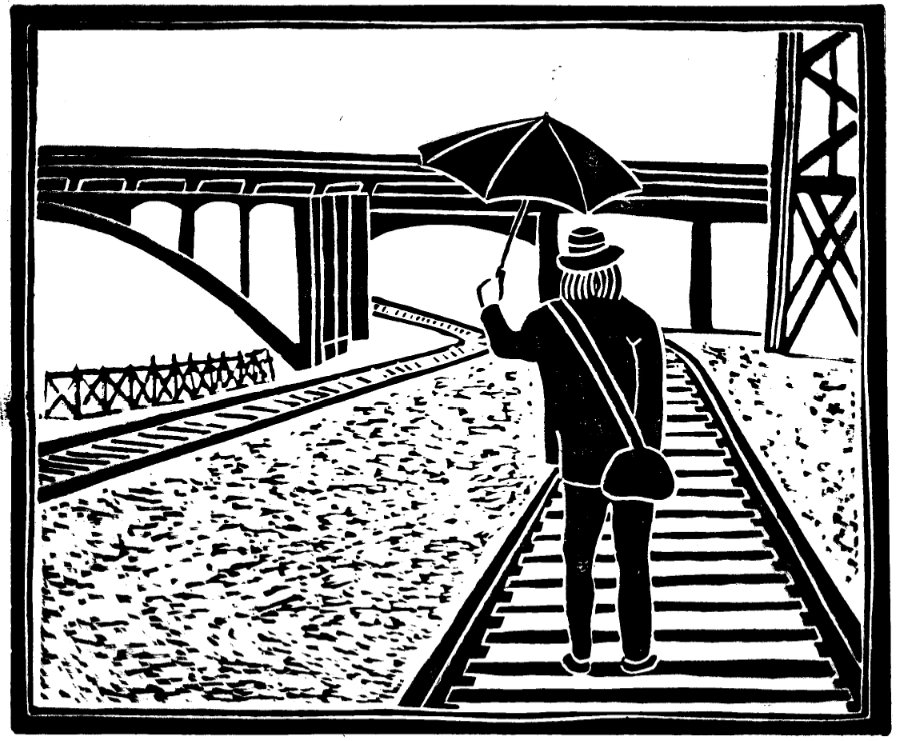
I finally found inspiration after traveling to Downtown Los Angeles with a friend. We took a walk beside the Los Angeles River across from Dodger Stadium and I noticed a homeless man writing in a journal. He wore a tattered suit and his shoes were scuffed and torn. He had an umbrella thought it was the heart of summer. He evoked the spirit of Kerouac and Woody Guthrie and Henry Miller. In an instant I knew the Woodcut Image I wanted to carve.
The festival sponsors asked that I write a short essay explaining how the image embodied the modern writer. Here is what I submitted:
The Man is walking the train tracks into the unknown. He takes his journey slowly, focusing on each step, unsure where the tracks will lead. His face is turned away from us emphasizing his anonymity. He wears his best suit--his only suit--as he carries his meager belongings on his back.
His umbrella shields him from the unrelenting sun and the birds who attempt to drop turds on his beloved fedora. The only people who notice him are the wayward souls who live beside the tracks. Some view the Man as a wayward soul as well. But his journey is not dictated by whim. This is his destiny.
He walks on the wooden railroad ties. This protects his shoes from damage and prevents footprints. He understands that good walking leaves no path behind.
He has faith his internal compass will kick in at some point. As he walks, his legs grow tired and heavy. Sometimes he becomes angry at his plight. He persists until he feels wings upon his back lifting him and easing his gait.
He always believed he would recognize his destination when he got there. Now he's sensing there is no place to get to. He is already there. He is the road and the knower of roads. (6" x 7", black ink print) (special thanks to Steven Tash and his awesome reference photos) (http://Flickr.com/photos/tashvibe)
My initial brainstorming elicited depressing ideas like a writer committing Hari-kiri with a fountain pen, the Greek character Sisyphus rolling a massive tome in a cart up a hill, a man drowning from the weight of typewriter tied to his leg. I rejected these early concepts as too dismal and cliched. Plus, who the hell uses a typewriter or fountain pen these days anyway.
I finally found inspiration after traveling to Downtown Los Angeles with a friend. We took a walk beside the Los Angeles River across from Dodger Stadium and I noticed a homeless man writing in a journal. He wore a tattered suit and his shoes were scuffed and torn. He had an umbrella thought it was the heart of summer. He evoked the spirit of Kerouac and Woody Guthrie and Henry Miller. In an instant I knew the Woodcut Image I wanted to carve.
The festival sponsors asked that I write a short essay explaining how the image embodied the modern writer. Here is what I submitted:
The Man is walking the train tracks into the unknown. He takes his journey slowly, focusing on each step, unsure where the tracks will lead. His face is turned away from us emphasizing his anonymity. He wears his best suit--his only suit--as he carries his meager belongings on his back.
His umbrella shields him from the unrelenting sun and the birds who attempt to drop turds on his beloved fedora. The only people who notice him are the wayward souls who live beside the tracks. Some view the Man as a wayward soul as well. But his journey is not dictated by whim. This is his destiny.
He walks on the wooden railroad ties. This protects his shoes from damage and prevents footprints. He understands that good walking leaves no path behind.
He has faith his internal compass will kick in at some point. As he walks, his legs grow tired and heavy. Sometimes he becomes angry at his plight. He persists until he feels wings upon his back lifting him and easing his gait.
He always believed he would recognize his destination when he got there. Now he's sensing there is no place to get to. He is already there. He is the road and the knower of roads. (6" x 7", black ink print) (special thanks to Steven Tash and his awesome reference photos) (http://Flickr.com/photos/tashvibe)
Tuesday, July 9, 2013
Chick Hearn
It was 2002 and the Lakers had just beaten the New Jersey Nets for their third straight NBA Championship. Being a huge Lakers fan, I took a subway to downtown LA to check out the parade. As I watched the double-decker buses carrying the players down Figueroa Avenue, I noticed Chick Hearn standing at the front of the first bus. He was leaning against the top rail, his hair dyed purple, his shirt drenched with sweat and champagne. While Shaq and Kobe waved to the crowd, Chick stared straight ahead. This was his ninth championship as Lakers announcer and at age 85, he was exhausted.
Less than two months later, Chick suffered a fall at his Encino home that took his life. The world's greatest basketball announcer was gone and Laker nation fell into mourning.
Francis Dayle "Chick" Hearn was born in 1916 in Aurora, Illinois. He played basketball at Bradley University and he earned his famous nickname from a prank played on him by teammates. He was given a box of sneakers and when he removed the lid he found a dead chicken inside.
Chick Hearn became the Lakers play-by-play man in 1961 after the team moved from Minneapolis to Los Angeles. His announcing style featured an enthusiastic, rapid-fire delivery peppered with colorful phrases and an offbeat sense of humor. Chick invented many of the terms that have become common basketball parlance. These include: Slam Dunk, Air Ball, Finger Roll, Give and Go, No Harm No Foul, Dribble Drive.
Chick also coined a number of phrases that became known as "Chickisms."
"94 x 50 Hunk of Wood"--referred to a basketball court.
"Bunny Hop in the Pea Patch"--when a player was called for traveling.
"The Mustard's off the Hot Dog"--when a player made a mistake while showing off.
"Yo-Yoing Up and Down"--dribbling the ball.
"Got caught with his Hand in the Cookie Jar"--a blatant foul by a player.
"Throws up a Brick"--a terrible shot.
"Heart-Brrreeak!"--a shot that goes in and out of the basket.
"Ticky-Tack"--a foul call when minimal contact is made.
"He couldn't throw a Pea in the Ocean"--when a player's shooting has gone cold.
"Put him in the Popcorn Machine and he's covered with Butter"--When a defensive player leaps in the air from a head fake and the opposing player scores on him.
If a player tried an impossible shot that had no chance of going in, Chick would say:
"He has two chances, slim and none and slim just left the building."
If that same impossible shot actually went in the basket, Chick had an alternative call:
"He throws up a prayer...and it's answered."
Whenever the Lakers had a lead that Chick deemed insurmountable, he would launch into his most famous phrase which guaranteed a Lakers victory.
"The game is in the refrigerator, the door is closed, the lights are out, the butter's getting hard, the eggs are cooling and the Jello is jiggling."
From 1961-1965, Chick missed only two Laker games, one due to laryngitis and the second after he missed a plane flight. In 1965, Chick began a new announcing streak which would reach 3338 consecutive Laker games. The streak came to an end in 2001 when Chick had cardiac bypass surgery.
Chick was possibly the most beloved of all Lakers personalities. In the days when the Lakers played at the Forum, fans could walk up to Chick before games and have a conversation. He was always friendly and smiling and he'd often mention a fan's birthday or offer a get well sentiment live on air.
Chick was also brutally honest. In 1998, Chick was honored for broadcasting 3000 consecutive games. The Lakers were losing to Orlando at halftime and after accepting his award, Chick told the crowd, "The Lakers look like dogs. If they play the third quarter like they played the first half, I'm going to buy them Alpo." The Lakers went on to win the game by double figures.
In 1991, Chick Hearn was inducted into the NBA Hall of Fame. He had a street named after him in Downtown LA and his name was hung from the rafters inside Staples Center beside Laker greats like Jerry West, Wilt Chamberlain and Magic Johnson. In 2010, a bronze statue of Chick was christened outside Staples Center. Chick is the only non-player to receive such a statue.
Chick and his wife Marge were married 64 years. They had two children, a son Gary who died of a drug overdose in 1972 and a daughter Samantha who died from complications of anorexia in 1991.
When Chick died in 2002, flags at Los Angeles City Hall were flown at half mast. Thousands of fans and numerous Laker greats showed up at Chick's funeral. Cardinal Roger Mahoney told mourners: "I am going to go outside and look up in the sky, because I think for the last time we will see the meteor go by and we will wave so long. This one's in the refrigerator." (6" x 8", black ink print)
Less than two months later, Chick suffered a fall at his Encino home that took his life. The world's greatest basketball announcer was gone and Laker nation fell into mourning.
Francis Dayle "Chick" Hearn was born in 1916 in Aurora, Illinois. He played basketball at Bradley University and he earned his famous nickname from a prank played on him by teammates. He was given a box of sneakers and when he removed the lid he found a dead chicken inside.
Chick Hearn became the Lakers play-by-play man in 1961 after the team moved from Minneapolis to Los Angeles. His announcing style featured an enthusiastic, rapid-fire delivery peppered with colorful phrases and an offbeat sense of humor. Chick invented many of the terms that have become common basketball parlance. These include: Slam Dunk, Air Ball, Finger Roll, Give and Go, No Harm No Foul, Dribble Drive.
Chick also coined a number of phrases that became known as "Chickisms."
"94 x 50 Hunk of Wood"--referred to a basketball court.
"Bunny Hop in the Pea Patch"--when a player was called for traveling.
"The Mustard's off the Hot Dog"--when a player made a mistake while showing off.
"Yo-Yoing Up and Down"--dribbling the ball.
"Got caught with his Hand in the Cookie Jar"--a blatant foul by a player.
"Throws up a Brick"--a terrible shot.
"Heart-Brrreeak!"--a shot that goes in and out of the basket.
"Ticky-Tack"--a foul call when minimal contact is made.
"He couldn't throw a Pea in the Ocean"--when a player's shooting has gone cold.
"Put him in the Popcorn Machine and he's covered with Butter"--When a defensive player leaps in the air from a head fake and the opposing player scores on him.
If a player tried an impossible shot that had no chance of going in, Chick would say:
"He has two chances, slim and none and slim just left the building."
If that same impossible shot actually went in the basket, Chick had an alternative call:
"He throws up a prayer...and it's answered."
Whenever the Lakers had a lead that Chick deemed insurmountable, he would launch into his most famous phrase which guaranteed a Lakers victory.
"The game is in the refrigerator, the door is closed, the lights are out, the butter's getting hard, the eggs are cooling and the Jello is jiggling."
From 1961-1965, Chick missed only two Laker games, one due to laryngitis and the second after he missed a plane flight. In 1965, Chick began a new announcing streak which would reach 3338 consecutive Laker games. The streak came to an end in 2001 when Chick had cardiac bypass surgery.
Chick was possibly the most beloved of all Lakers personalities. In the days when the Lakers played at the Forum, fans could walk up to Chick before games and have a conversation. He was always friendly and smiling and he'd often mention a fan's birthday or offer a get well sentiment live on air.
Chick was also brutally honest. In 1998, Chick was honored for broadcasting 3000 consecutive games. The Lakers were losing to Orlando at halftime and after accepting his award, Chick told the crowd, "The Lakers look like dogs. If they play the third quarter like they played the first half, I'm going to buy them Alpo." The Lakers went on to win the game by double figures.
In 1991, Chick Hearn was inducted into the NBA Hall of Fame. He had a street named after him in Downtown LA and his name was hung from the rafters inside Staples Center beside Laker greats like Jerry West, Wilt Chamberlain and Magic Johnson. In 2010, a bronze statue of Chick was christened outside Staples Center. Chick is the only non-player to receive such a statue.
Chick and his wife Marge were married 64 years. They had two children, a son Gary who died of a drug overdose in 1972 and a daughter Samantha who died from complications of anorexia in 1991.
When Chick died in 2002, flags at Los Angeles City Hall were flown at half mast. Thousands of fans and numerous Laker greats showed up at Chick's funeral. Cardinal Roger Mahoney told mourners: "I am going to go outside and look up in the sky, because I think for the last time we will see the meteor go by and we will wave so long. This one's in the refrigerator." (6" x 8", black ink print)
Subscribe to:
Posts
(
Atom
)